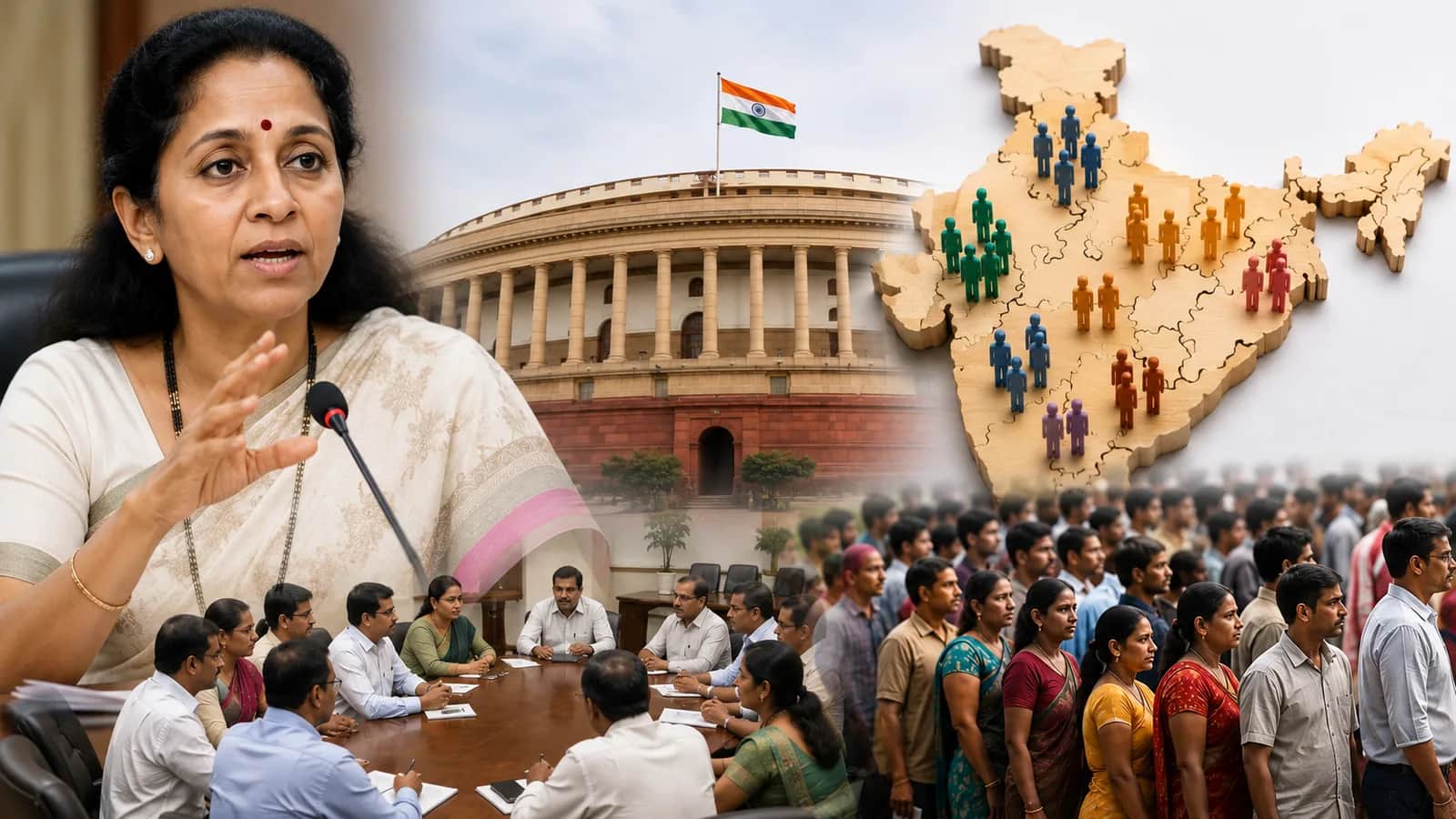
As India prepares for a fresh delimitation exercise after 2026, the issue has once again taken centre stage in national politics. The debate gained fresh momentum after Supriya Sule, Working President of the Nationalist Congress Party (Sharadchandra Pawar faction) and Member of Parliament from Baramati, expressed concerns over the Centre’s proposed approach to delimitation.
Sule has made it clear that her party is not against the idea of delimitation. However, she believes that the process must be fair to every state and should not penalise those that have successfully controlled their population over the past few decades.
What is Delimitation?
Delimitation is the process of redrawing the boundaries of Lok Sabha and State Assembly constituencies based on changes in population. The objective is to ensure that every elected representative speaks for roughly the same number of people, making elections more balanced and representative.
This process is carried out by an independent Delimitation Commission, whose recommendations become legally binding once they are notified.
Why Is It Back in the News?
The current discussion is linked to the constitutional freeze on the redistribution of Lok Sabha seats, which is scheduled to end after 2026.
India has carried out delimitation exercises in 1952, 1963, 1973 and 2002. However, during the Emergency, the 42nd Constitutional Amendment in 1976 froze the redistribution of parliamentary seats. The reasoning was straightforward—states that had successfully implemented family planning programmes should not lose political representation simply because their population had grown more slowly.
In 2001, the 84th Constitutional Amendment extended this freeze until the first Census conducted after 2026. While constituency boundaries were adjusted using the 2001 Census, the number of Lok Sabha seats allotted to each state remained unchanged.
Now that the freeze is nearing its end, the question of how seats should be redistributed has become a politically sensitive issue.
Why Is Supriya Sule Concerned?
Supriya Sule believes that states such as Maharashtra, Tamil Nadu, Kerala, Karnataka and Andhra Pradesh, which invested heavily in education, healthcare and family planning, should not be placed at a disadvantage.
If parliamentary seats are redistributed purely on the basis of the latest population figures, states with higher population growth could gain more seats in the Lok Sabha. In contrast, states that successfully slowed population growth may see their relative influence in Parliament reduced.
According to Sule, that would send the wrong message. She has said that her party will support a Delimitation Bill only if the Centre provides assurances that all states will be treated fairly. One suggestion that has emerged in the debate is to increase the overall number of Lok Sabha seats in a way that expands representation without disproportionately reducing the voice of any state.
A Debate That Goes Beyond Politics
The controversy is not just about numbers or electoral boundaries. It touches the core of India’s federal structure.
Supporters of delimitation argue that democracy works best when every MP represents a similar number of people. Since India’s population has changed significantly over the past five decades, they believe parliamentary representation should reflect today’s realities.
Critics, however, argue that population alone should not decide political representation. They believe states that followed national development goals and invested in population control should not lose influence because of policies that the Union government itself once encouraged.
This difference of opinion has turned delimitation into one of the most significant constitutional and political debates facing the country.
Looking Ahead
The Centre has not yet announced the final framework for the next delimitation exercise, but discussions are already shaping the political narrative.
Supriya Sule’s remarks reflect a broader concern shared by several regional parties, that any future delimitation exercise must strike a balance between equal representation and federal fairness.
As India prepares for one of the biggest electoral reforms in decades, the decisions taken in the coming years will not only redraw constituency boundaries but could also reshape the country’s political landscape for generations to come.
"As India prepares for a fresh delimitation exercise after 2026, the issue has once again taken centre stage in national politics. The debate…"