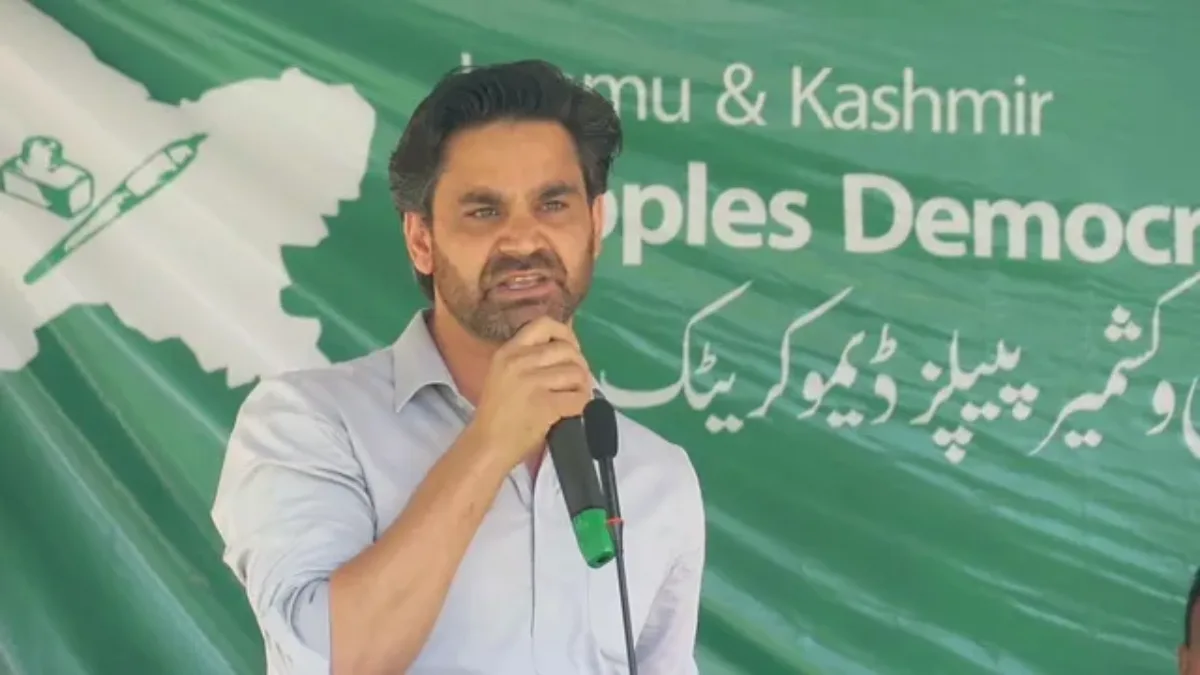
Legislator Waheed Para of the Peoples Democratic Party (PDP) has proposed a bill designed to tackle the long-term consequences of "sustained below-replacement fertility" using voluntary, rights-based and non-coercive approaches.
Introduced during the ongoing Monsoon Session, the Bill seeks to enhance enforcement against sex selection and sex-selective practices in Jammu and Kashmir, a region where the fertility rate has been falling over the past few years.
The Bill indicates that Jammu and Kashmir’s total fertility rate is approximately 1.4 children per woman, below the standard replacement level of 2.1, according to the National Family Health Survey-5.
The "Ma-Beti aur Aane Wali Naslein Bachao Bill" seeks to safeguard women, adolescent girls, maternal and child health, as well as future generations of Kashmir, from demographic decline.
According to sources, Para said Jammu and Kashmir is facing a serious demographic decline, with its fertility rate falling to around 1.4 children per woman, among the lowest in the country. He said the decline is occurring faster than in other parts of India, despite the national fertility rate also remaining below the replacement level.
Para Raises Concerns Over Falling Fertility And Reproductive Health
Para described it as an "extinction of time" that no one is discussing, noting that soon there will be no young people left to work or children to carry on the culture, leaving behind an aging, shrinking and traumatised society disappearing in silence.
He stated that “the next generation is being gutted before it is even born due to late marriages, mass voluntary bachelorhood, rising divorce, crushing financial pressure, and rising infertility”.
Para stressed that although PCOS receives attention, menstrual disorders, anaemia, nutritional deficiencies and other reproductive health concerns also require early detection, screening, counselling and timely medical referrals. He stated that girls should not be compelled to leave school because of menstruation, marriage, pregnancy, motherhood, poverty, disability or family circumstances.
Bill Focuses On Reproductive Rights
The Bill asserted that the State has a valid interest in making sure every girl and young woman receives a meaningful opportunity. The State must create an environment in which individuals and couples can make reproductive decisions freely and with full awareness, free from pressure, discrimination or financial compulsion.
It also advocates for reproductive and child health education suited to different age groups, continuation and completion of education for girls and young women up to age thirty, enhanced maternal and child healthcare services, financial and educational support for families with children, and protection of women’s dignity, privacy, autonomy and reproductive rights.
"Legislator Waheed Para of the Peoples Democratic Party (PDP) has proposed a bill designed to tackle the long-term consequences of "sustained…"