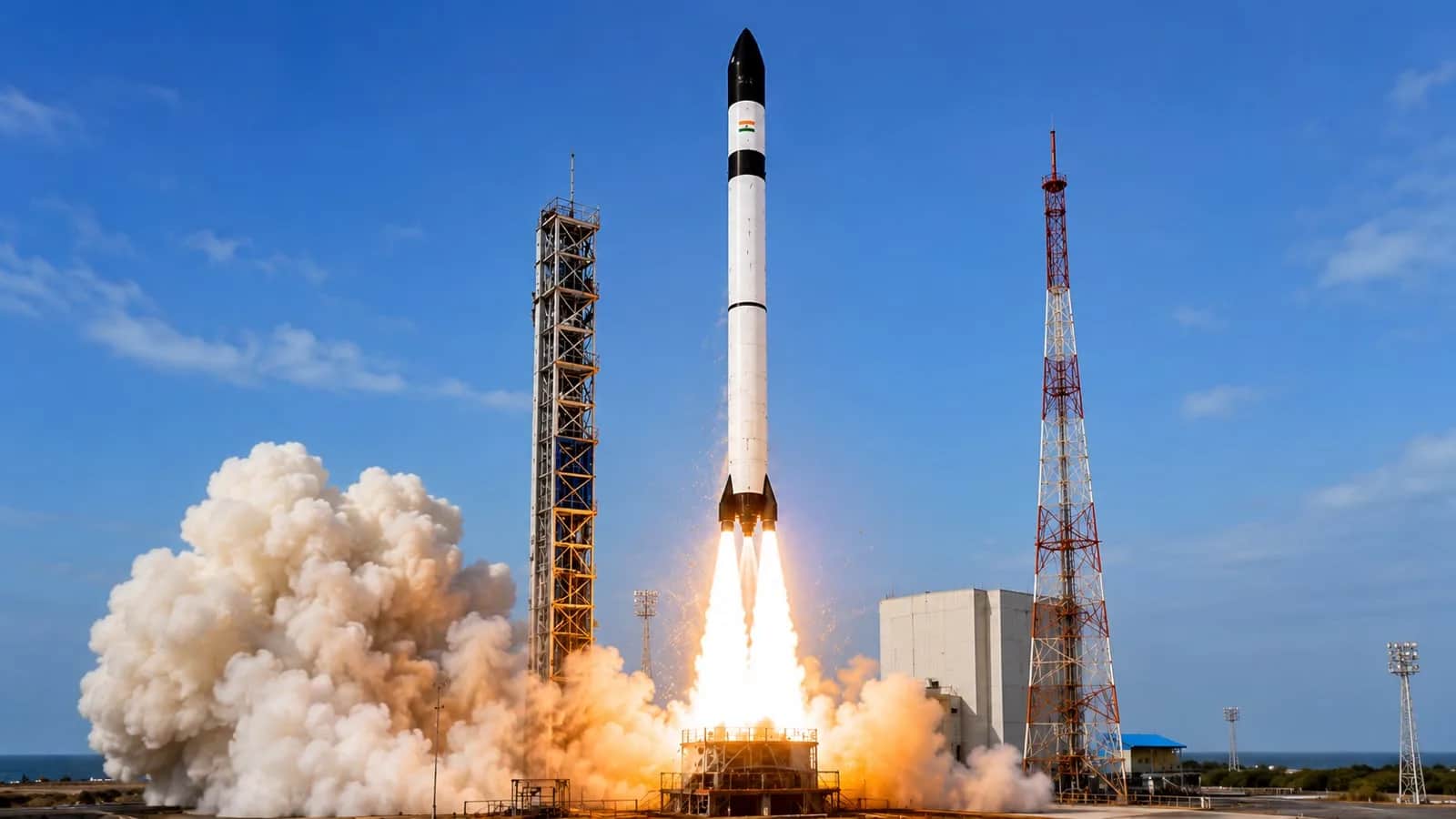
Every milestone in India’s space journey has a story behind it. From launching its first satellite to landing near the Moon’s south pole, the country has steadily pushed the boundaries of what is possible. Now, another chapter has been added to that journey. Skyroot Aerospace has successfully launched Vikram-1, India’s first privately developed orbital rocket, from the Satish Dhawan Space Centre (SDSC-SHAR) in Sriharikota, Andhra Pradesh.
The mission, called Mission Aagaman, is more than just another rocket launch. It marks the first time an Indian private company has built and launched an orbital launch vehicle, showing how India’s space sector is evolving beyond government-led missions.
Prime Minister Narendra Modi called the launch a “historic new frontier” in India’s space journey, saying it reflects the innovation and entrepreneurial spirit of the country’s young minds. The rocket also carried a symbolic message into space, a commemorative card bearing the words “Vande Mataram” from the Prime Minister, along with hundreds of handwritten wishes and aspirations sent by people from around the world. It was a small gesture, but one that made the mission feel deeply personal.
A Startup That Dreamed Big
The story of Vikram-1 began in 2018, when two former ISRO scientists, Pawan Kumar Chandana and Naga Bharath Daka, decided to take a leap of faith. Having spent years working on India’s space programme, they believed the future of space exploration would increasingly depend on private companies that could launch satellites quickly, efficiently, and at a lower cost. That belief led to the birth of Skyroot Aerospace in Hyderabad.
The company named its rockets after Dr. Vikram Sarabhai, the visionary scientist who laid the foundation of India’s space programme. For the founders, it was a way of honouring the man who proved that space technology could improve everyday life.
Their first major breakthrough came in 2022 with the successful launch of Vikram-S, India’s first privately built rocket. Although it was a suborbital mission, it proved that the team had the technical expertise to build reliable launch vehicles. Over the next few years, Skyroot carried out extensive testing of engines, propulsion systems, avionics, and stage-separation technology before finally unveiling Vikram-1, a rocket capable of placing satellites into orbit.
What Makes Vikram-1 Special?
Standing around 20 metres tall, the rocket is a four-stage orbital launch vehicle capable of carrying payloads of up to 350 kilograms into Low Earth Orbit. It uses three solid-fuel stages for powerful lift-off and a restartable liquid-fuel upper stage, allowing satellites to be released more accurately into their intended orbits.
One of its biggest strengths is its all-carbon composite structure. Unlike traditional metal-bodied rockets, carbon-fibre composites are lighter, stronger, and more heat-resistant. A lighter rocket needs less fuel, making launches more efficient and reducing overall costs.
Skyroot has also developed much of the rocket's technology in-house, including advanced avionics, guidance systems, solid propulsion, and 3D-printed rocket engines. These technologies reduce manufacturing time while improving precision and reliability. Before reaching the launch pad, every major system, including propulsion, stage separation, navigation, and control underwent years of testing. Nearly 80% of the technologies had already been validated during the successful Vikram-S mission in 2022.
Why Is Sriharikota India’s Space Gateway?
If you’ve ever wondered why almost every Indian rocket lifts off from Sriharikota, the answer lies in both geography and science.
Located on a narrow island along the Bay of Bengal, Sriharikota gives rockets a natural advantage. Launching eastward allows them to benefit from the Earth’s rotation, helping them gain extra speed while using less fuel. This makes missions more efficient and allows rockets to carry heavier payloads.
The location is also much safer. As rockets discard different stages during flight, those sections fall into the open sea instead of populated areas. Over the years, the Satish Dhawan Space Centre has grown into one of the world’s most reliable launch facilities, supporting iconic missions such as Chandrayaan, Mangalyaan, Aditya-L1, and now Vikram-1.
A Moment That Goes Beyond One Rocket
The success of Mission Aagaman is not just about one company or one launch. It reflects how India’s space ecosystem has changed in recent years, with startups working alongside ISRO to develop cutting-edge technology and compete in the global space economy.
For Skyroot Aerospace, Vikram-1 is the result of years of planning, testing, setbacks, and determination. For India, it is proof that world-class innovation is no longer limited to government agencies alone.
As demand for satellite launches continues to grow worldwide, missions like Vikram-1 could help India become a major player in the commercial space industry. More importantly, they remind us that some of the country’s biggest achievements begin with a simple idea, and the courage to pursue it.
NOTE: As of the latest official updates available today, the scheduled liftoff has been temporarily put on hold due to technical observation during the countdown. The launch window remains open, and Skyroot Aerospace is expected to announce a revised launch time after completing safety checks.
"Every milestone in India’s space journey has a story behind it. From launching its first satellite to landing near the Moon’s south pole, th…"