
On most mornings, Mohammad Ali Jauhar University looks like any other university campus. Students rush to classrooms with backpacks slung over their shoulders. Some gather outside the canteen over cups of tea, while others hurry to the library before lectures begin. It is the kind of routine that plays out in colleges across the country.
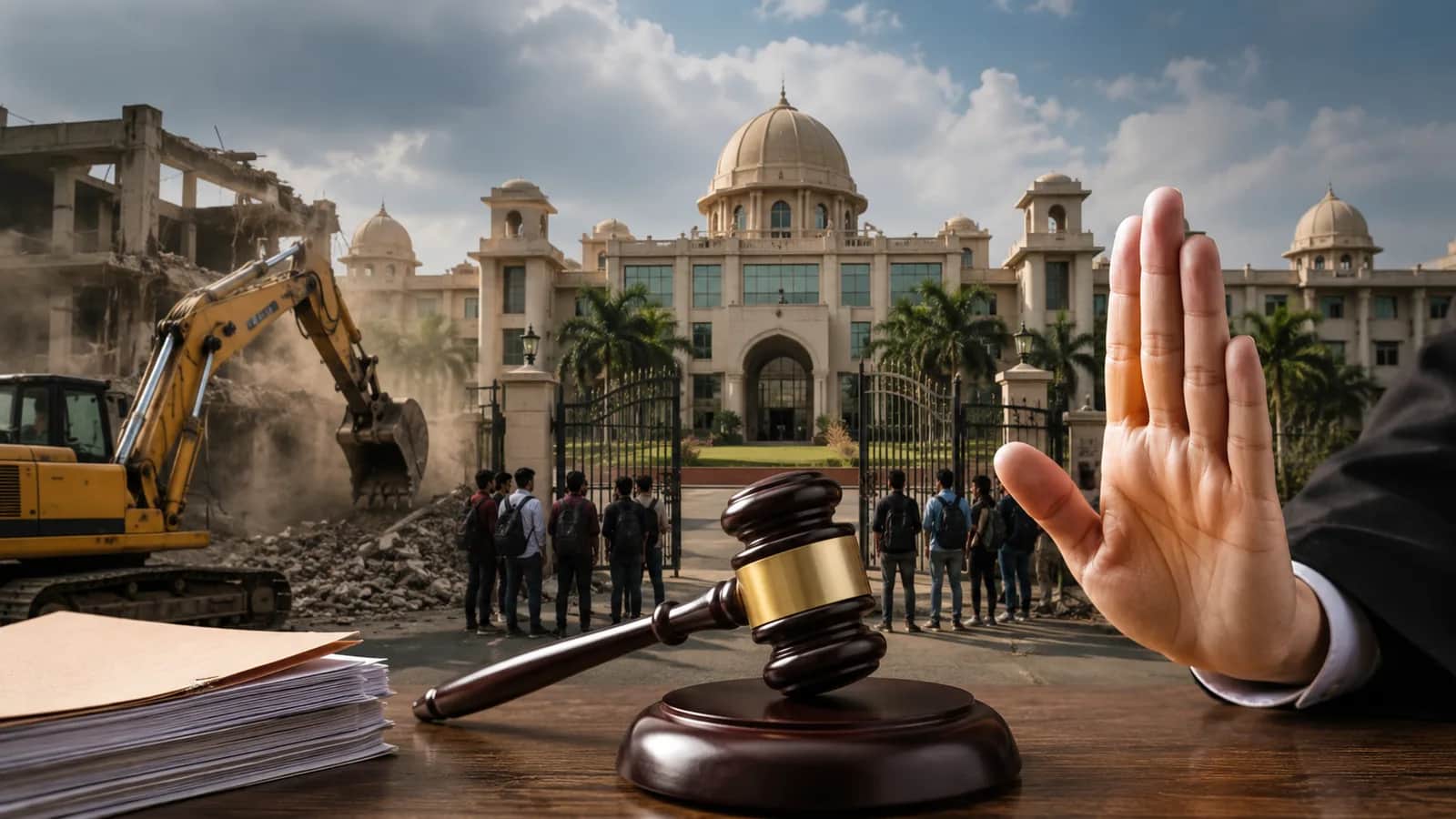
But over the past few days, that routine has been interrupted by a different conversation. Not about exams. Not about placements. But about demolition. The news that nearly 40 buildings on the campus could be demolished has left students worried and parents anxious. Just when it seemed the bulldozers would move in, the Moradabad Divisional Commissioner ordered a temporary stay on the demolition, offering a brief sense of relief. For now, the buildings are still standing. But the uncertainty remains.
The idea that changed Rampur
Long before the courtrooms and legal notices, there was an idea. In the early 2000s, Rampur was known for its rich history and political significance, but it wasn't exactly a destination for higher education. Many students had to leave the district if they wanted to study medicine, engineering or law. It was around this time that senior Samajwadi Party leader Azam Khan spoke about creating a university that would bring quality education closer to home. His supporters remember it as a dream that many dismissed as unrealistic. Why can't Rampur have a university that competes with the best? was the question he often raised in public meetings. The answer came in the form of Mohammad Ali Jauhar University.
Named after freedom fighter, journalist and educationist Maulana Mohammad Ali Jauhar, the university was envisioned as more than just a campus. It was meant to become a centre of learning for students who often found quality education beyond their financial reach.
Brick by brick, lecture halls, hostels, libraries and laboratories began to rise from what was once open land. For many families, especially those from nearby districts, it felt like opportunity had finally arrived at their doorstep.
More than just buildings
Over the years, the university grew rapidly. Medicine, engineering, pharmacy, law, management, education, the list of courses kept expanding. The campus itself became a landmark. Visitors often described it as a small city, complete with wide roads, academic blocks, hostels and a teaching hospital. Thousands of students enrolled. Some were the first in their families to attend college. Some travelled hundreds of kilometres to study there. For them, Jauhar University wasn't associated with politics. It was simply where they studied, made friends and planned their future.
Then the questions began
But almost as quickly as the university grew, so did the allegations surrounding it. Investigating agencies claimed that parts of the land used for the campus had been acquired illegally. They alleged that government land, enemy property and land belonging to farmers had been included in the university. Over the years, multiple criminal cases were filed against Azam Khan and members of his family. The accusations ranged from illegal land acquisition and encroachment to forgery and manipulation of land records. Azam Khan denied every allegation. His supporters argued that the cases were politically motivated. The Uttar Pradesh government insisted that the law was simply taking its course. As court cases multiplied, the university's identity slowly changed. It was no longer discussed only as an educational institution. It had become a political headline.
The bulldozer arrives
This month, the controversy reached a new stage. The Rampur Development Authority (RDA) issued demolition notices for around 40 buildings inside the university campus. According to officials, these structures had been built without the required approvals under development regulations. From the administration's point of view, it was a matter of enforcing planning laws. From the university's point of view, it threatened years of hard work and the future of thousands of students. Inside the campus, uncertainty spread quickly.
Students began asking questions no timetable could answer. Would classrooms be sealed? Would hostels be affected? Would the next semester even begin on time?
A pause, not an end
Before any demolition could take place, the Mohammad Ali Jauhar Trust challenged the order. The matter reached the Moradabad Divisional Commissioner, who directed that the demolition should remain on hold until further orders. The stay brought relief, but only for the moment. The legal battle is far from over. Both sides will now present their arguments before the appellate authority decides whether the demolition notices should remain or be withdrawn.
Why the debate goes beyond one university
Today, the discussion isn't just about buildings. Supporters of the university argue that students should not pay the price for a dispute involving the institution's management. Critics counter that educational institutions cannot be exempt from the law if rules have been violated. Political parties have entered the debate, each presenting its own version of the story. Meanwhile, students continue attending classes, waiting for a decision that could shape their future.
The road ahead
For now, the bulldozers have stopped. The classrooms remain open. The campus continues to function. But the future of Jauhar University will ultimately be decided not by political speeches or television debates, but inside a courtroom. Whatever the final verdict, the case has already become much larger than one university. It is now a story about the collision of ambition, law, politics and education, a reminder that when institutions become the centre of legal battles, it is often the students who are left waiting for answers.
"On most mornings, Mohammad Ali Jauhar University looks like any other university campus. Students rush to classrooms with backpacks slung ov…"