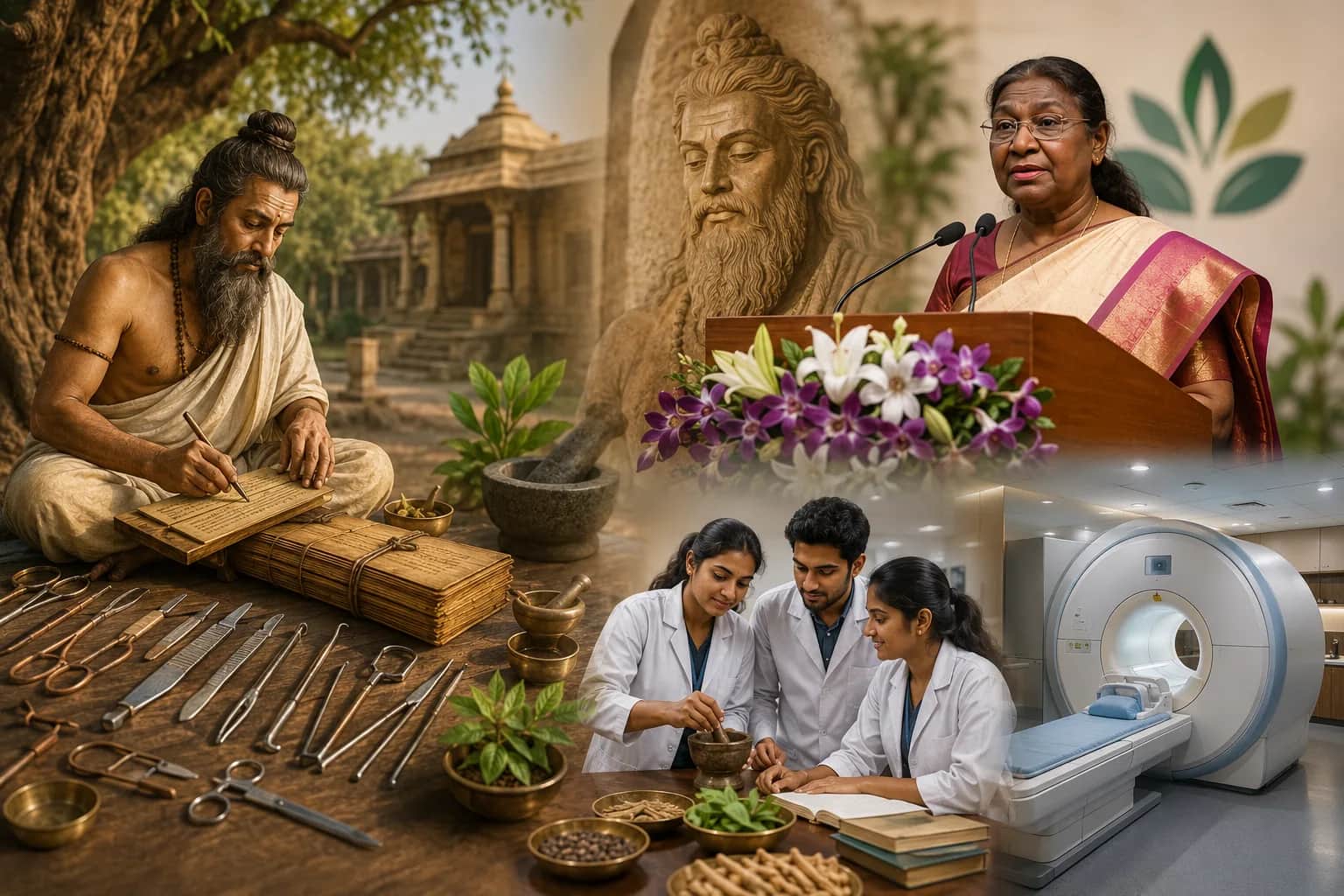
Imagine living in a world where there were no hospitals, no operation theatres, no anaesthesia, and no advanced medical equipment. Now imagine someone performing delicate surgeries in that world and doing them so well that people are still talking about his work more than 2,500 years later.
That person was Acharya Sushruta, the ancient Indian physician who is widely known as the Father of Surgery. His story isn’t just about history. It’s about curiosity, innovation, compassion, and a belief that medicine should always serve humanity. Even today, his ideas continue to inspire doctors, researchers, and healthcare professionals around the world.
It was this extraordinary legacy that took centre stage as President Droupadi Murmu inaugurated Saushrutam 2026, a three-day international conference on Ayurvedic surgery, at the All India Institute of Ayurveda (AIIA), New Delhi, on the occasion of Sushruta Jayanti. She also inaugurated AIIA’s new MRI facility, a reminder that ancient wisdom and modern technology don’t have to compete, they can work together.
A Conference That Looks Ahead, Not Back
At first glance, Saushrutam 2026 may seem like another medical conference. But its purpose goes far beyond lectures and presentations.
Doctors, surgeons, researchers, teachers and Ayurveda experts from India and several other countries have come together with a shared goal, to understand how centuries-old medical knowledge can continue to improve healthcare in today’s fast-changing world.
The conversations are not about choosing between Ayurveda and modern medicine. Instead, they focus on how the two can learn from each other through research, innovation and scientific validation.
The Man Who Was Centuries Ahead of His Time
Long before modern medical textbooks existed, Acharya Sushruta was documenting surgical techniques with astonishing detail.
Believed to have lived around the 6th century BCE, he authored the Sushruta Samhita, one of the world’s oldest medical texts. The book describes hundreds of surgical procedures and dozens of specialised instruments. It explains how to treat fractures, remove tumours, perform cataract surgeries and even reconstruct damaged noses, procedures that seem remarkable even by today’s standards. But what truly set Sushruta apart wasn’t just his medical knowledge.
He believed that a good doctor wasn’t defined only by skill. A healer, according to him, needed patience, honesty, compassion and humility. Knowledge could save lives, but character determined how that knowledge was used.
More Than an Oath- A Way of Life
Before many Ayurveda graduates begin their medical careers, they take the Sushruta Oath. Like the Hippocratic Oath followed by doctors worldwide, it is a promise to uphold the values that define the medical profession.
It reminds doctors to treat every patient with respect, maintain confidentiality, practise honestly and always place the patient’s well-being above personal interests.
In her address, President Murmu urged young doctors and researchers to carry these values throughout their careers. She encouraged them to stay curious, embrace scientific research and use modern technology without losing sight of the compassion that lies at the heart of medicine.
Why the World Is Looking at Ayurveda Again
Healthcare is changing. Today, people are no longer interested only in treating diseases after they occur. They also want to know how to stay healthy, manage stress, improve their lifestyle and prevent illnesses before they begin. This is where Ayurveda has found renewed relevance.
Its emphasis on prevention, balanced living, personalised care and overall well-being has attracted growing global interest. While modern medicine continues to play an essential role in treating diseases, Ayurveda offers insights into maintaining long-term health.
At the same time, experts agree that traditional knowledge must be supported by scientific evidence. President Murmu emphasised that India must preserve its ancient medical heritage while strengthening it through research, innovation, better documentation and digital healthcare so that Ayurveda earns greater recognition worldwide.
A Legacy That Continues to Heal
Saushrutam 2026 is not simply about celebrating a legendary physician from the past. It is about carrying forward an idea that medicine should never stop learning.
More than 2,500 years have passed since Acharya Sushruta first documented his knowledge, yet his message feels just as relevant today. Technology has changed, hospitals have evolved and surgeries have become more advanced, but the purpose of medicine remains the same. To heal with knowledge. To serve with compassion. And to remember that behind every treatment is a human life waiting for hope.
" Imagine living in a world where there were no hospitals, no operation theatres, no anaesthesia, and no advanced medical equipment. Now imag…"