
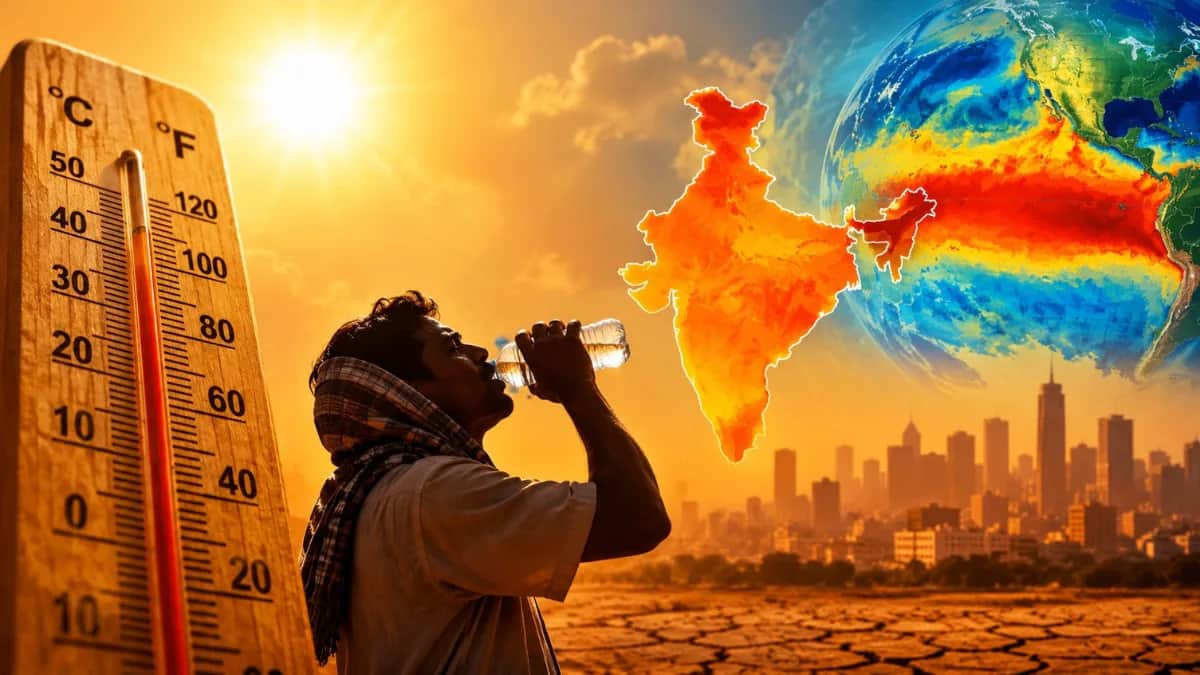
According to a recent analysis by the University of Chicago's Climate Impact Lab, India is expected to see approximately 15,800 additional heat-related deaths between September 2026 and February 2027 compared to a typical year, largely due to the prevailing “Super El Niño.”
According to a report from the Climate Impact Lab (CIL), the ensuing temperature spike is expected to raise global land temperatures by 1.2°C, resulting in 44% more extremely hot days than anticipated in a typical year. It will expose populations to conditions similar to the higher temperatures that climate change is projected to bring about in 20 years.
According to the analysis, the current El Niño episode is projected to cause 4,51,000 additional deaths worldwide during the forecast period, with 2,39,000 of those deaths expected over the six-month period from September 2026 to February 2027.
What is El Niño?
El Niño is a climate phenomenon that can affect rainfall and temperature patterns and causes anomalous warming of sea surface temperatures in the eastern Pacific Ocean.
The report's co-author, Emily Grover-Kopec, stated that the mortality estimates are derived from CIL's study on the relationship between temperature and excess deaths, which was developed independently for 24,378 locations globally to take into consideration local climate, vulnerability and adaptation capacity.
India Among Worst-Hit Countries
There will likely be an additional 66,800 deaths in the Sahel regions of Nigeria, Sudan, Niger and Chad.
India is projected to be among the fourth most severely affected countries after Nigeria, Indonesia and Sudan. An estimated 19,400 additional deaths are projected in the Southeast Asian countries of the Philippines, Vietnam, Thailand and Cambodia.
The authors of the report, Michael Greenstone, Tamma Carleton, Genevieve Maricle and Grover-Kopec, point out that rather than peaking early, India's death toll is anticipated to increase over time. The country is projected to see an additional 7,400 heat-related deaths between December 2026 and February 2027 alone.
The researchers explicitly identify India and Pakistan as Northern Hemisphere countries whose heat-related mortality will likely continue to rise throughout their summer months, beyond the current projection period.
In response to questions about estimates of increased mortality in India from winter to spring, Grover-Kopec stated, “Northern India's winters are normally cold enough that heat rarely drives deaths there – so a warmer-than-usual winter won't move the numbers much.”
CIL contends that since deaths can be predicted months ahead, governments and humanitarian groups have time to act through early-warning systems for heat, cooling centres, hydration stations, worker safeguards and broader health outreach.
The authors refer to the current heatwave as a “postcard from the future,” contending that the extra warning time, relative to long-term climate change, offers India and other vulnerable countries an opportunity to respond before, rather than after, fatalities happen.
"According to a recent analysis by the University of Chicago's Climate Impact Lab, India is expected to see approximately 15,800 additional h…"