
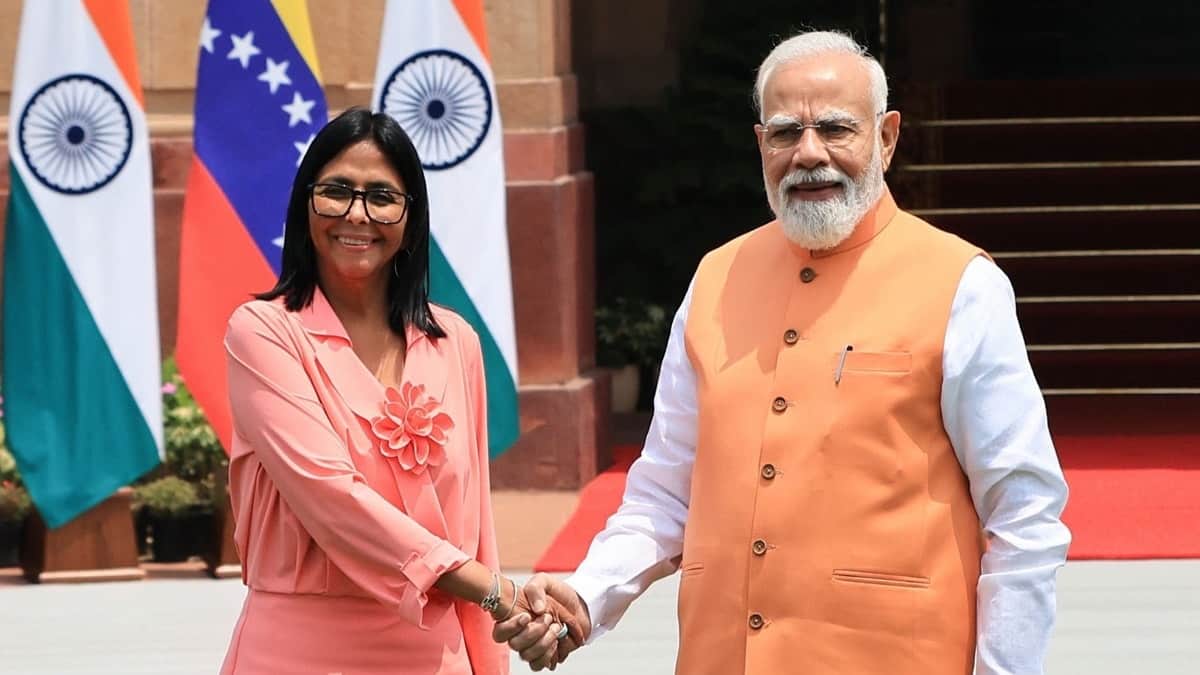
Venezuela’s acting President Delcy Rodriguez is currently on a five-day visit to India from June 3 to June 7, accompanied by a high-level delegation of ministers and senior government officials. During the visit, Rodriguez held talks with Prime Minister Narendra Modi and is also scheduled to meet top Indian energy industry leaders and business executives.. The visit comes at a time when India is rapidly increasing crude oil imports from Venezuela and looking for alternative energy sources amid growing instability in global oil markets.
The discussions are not limited to oil alone. According to Indian officials, both sides are exploring cooperation in energy, trade, investment, pharmaceuticals, healthcare, transportation, renewable energy, mining and critical minerals. However, energy remains the centrepiece of the talks.
Why India is interested in Venezuela right now?
The answer lies in the ongoing crisis in the Middle East.
India imports nearly 90% of its crude oil requirements, making it highly dependent on global energy markets. The recent conflict involving Iran and disruptions around the Strait of Hormuz have raised concerns about supply security and shipping routes. As a result, New Delhi has been actively searching for reliable alternative suppliers.
That is where Venezuela enters the picture.
Home to the world’s largest proven oil reserves, Venezuela has re- emereged as a major supplier for India. In May alone , India imported around 427,000 barrels of Venezuelan crude per day, making it Venezuelan’s second-largest buyer after the Unites States. Venezuelan oil has now become one of the India’s top crude import sources.
What exactly is being discussed?
Indian and Venezuelan officials have discussed cooperation in both upstream and downstream energy sectors.
Upstream cooperation includes oil exploration and production, while downstream projects involve refining, storage, transportation and distribution. Officials have also discussed possible Indian investments in Venezuela’s energy infrastructure and opportunities in critical minerals and mining.
Beyond energy, the two countries are exploring stronger partnerships in pharmaceuticals, agriculture, healthcare and industrial investment. The broader goal appears to be transforming the relationship from a simple oil-trading partnership into a long-term strategic economic partnership.
The US Angle: Why Washington is Watching Closely?
No story involving Venezuela’s oil industry is complete without mentioning the Unites States.
For years, US sanctions severely restricted Venezuela’s oil exports and discouraged foreign investment in its energy sector. Those sanctions were one of the main reasons India’s imports of Venezuelan crude declined in previous years. However, recent changes in the sanctions environment and new energy arrangements have allowed Venezuelan oil exports to recover. This has created fresh opportunities for countries such as India to expand purchases.
At the same time, Washington continues to play a significant role in shaping how global companies engage with Venezuela’s energy sector. Analysts believe the growing India-Venezuela partnership will be closely watched in the Unites States, especially as India remains one of Washington’s most important strategic partners in Asia.
What could be the impact on India?
For India, the biggest advantage is energy security.
A stronger partnership with Venezuela would help diversify crude oil imports and reduce dependence on a limited number of suppliers. Access to Venezuelan crude could also provide Indian refiners with greater flexibility during periods of global supply disruptions.
Additionally, cooperation in critical minerals could support India’s ambitions in electric vehicles, renewable energy and advanced manufacturing sectors. If discussions translate into concrete agreements, Indian companies could gain access to new investment opportunities in one of the world’s most resource-rich countries.
A Relationship Looking Beyond Oil
While energy remains the driving force behind Delcy Rodriguez’s visit, the broader message is clear: both countries are looking beyond traditional trade and exploring a deeper strategic partnership.
At a time when global energy routes are under pressure and geopolitical alignments are shifting. India and Venezuela appear determined to strengthen ties. Whether the discussions result in major agreements remains to be seen, but the visit has already highlighted the growing importance of Venezuela in India’s long- term energy and economic planning.
Delcy Rodriguez’s Personal Connection to India
Delcy Rodriguez’s visit is not solely about diplomacy and energy. She is also known for having a personal spiritual connection with India. Over the past few years, Rodriguez has visited Sathya Sai Baba’s Prasanth Nilayam Ashram in Puttaparthi, Andhra Pradesh, on multiple occasions and has publicly spoken about the influence of the late spiritual leader on her life. Reports and videos released by the Sai Baba organization show Rodriguez paying respects at the Ashram during visits in 2023 and 2024.
Interestingly, Rodriguez is not only Venezuelan leader associated with Sai Baba’s teachings. Former President Nicolas Maduro and members of his inner circle have also expressed admiration for the Indian spiritual leader. Rodriguez has previously said that Sai Baba’s teachings of peace, love and service helped for through difficult periods and gave her strength during challenging moments.
While these spiritual beliefs do not directly influence government policy, they add a unique personal dimension to India-Venezuela relations. For Rodriguez, India is not just an important economic partner but also a country with which she shares a longstanding spiritual connection.
"Venezuela’s acting President Delcy Rodriguez is currently on a five-day visit to India from June 3 to June 7, accompanied by a high-level de…"