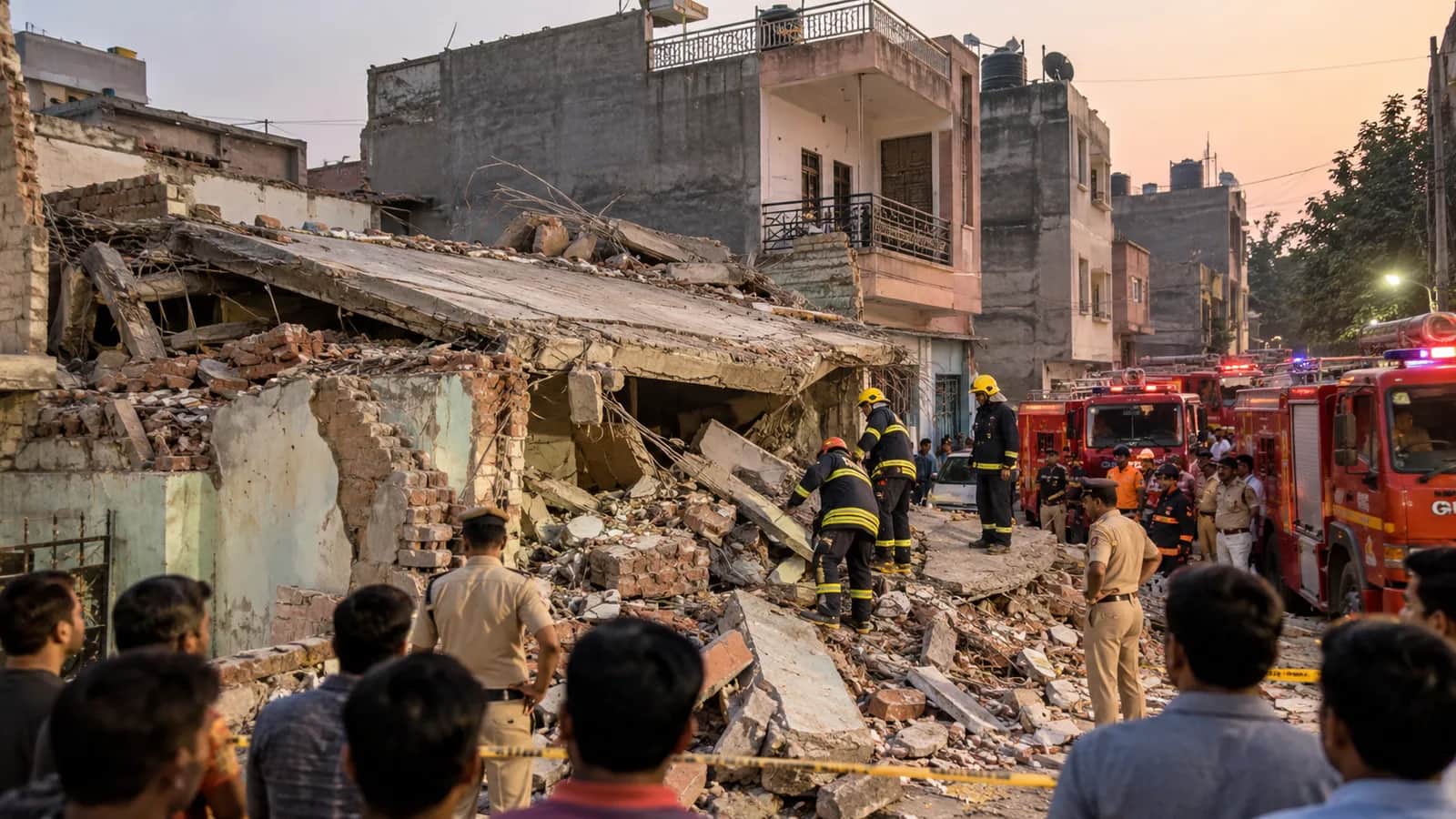
New Delhi: A house in Harsh Vihar in northeast Delhi collapsed on October 25 following construction work on the existing structure, prompting a rescue operation involving the Delhi Fire Services and other agencies. According to The Times of India, five fire tenders were dispatched to Milan Garden after an emergency call was received at around 6.46 pm. The incident comes weeks after building collapses in Seemapuri and Satya Niketan claimed a combined 12 lives.
The house was reportedly an old ground-floor structure on which an additional floor was being constructed. The concrete roof, or lanter, had been laid earlier that day before the building collapsed.
Initial reports suggested that two workers might have been inside the structure at the time of the incident. Police, fire personnel and other emergency responders reached the site to conduct rescue operations and assess the situation. The cause of the collapse and the final casualty count were not confirmed in the initial reports.
What Did Authorities Do After the Collapse?
Following the collapse, the Delhi Fire Services dispatched five fire tenders to Milan Garden. Aaj Tak reported that police officers and emergency responders reached the site, while teams from the Delhi Disaster Management Authority (DDMA) and the Municipal Corporation of Delhi (MCD) joined the response.
According to Aaj Tak rescue personnel worked to clear the debris and establish whether anyone remained trapped inside. Initial reports also identified the house owner as Kulwinder Tanwar, who reportedly told officials that two workers might have been inside the structure.
The cause of the collapse remained under investigation. The possibility that the old structure could not bear the weight of the newly laid concrete roof was raised, but this had not been established as the definitive cause in the initial reports.
Seemapuri Building Collapse: Earlier Incident That Claimed Five Lives
On October 7, a multi-storey residential building collapsed near Idgah Machhli Mandi in northeast Delhi’s Seemapuri area. The Indian Express reported that the death toll rose to five the following day after rescuers recovered two more bodies from the debris. Eight people were injured and taken to Rajiv Gandhi Super Speciality Hospital in Tahirpur.
Among the deceased were a 21-year-old woman, who was around four months pregnant, a 12-year-old girl, a child aged approximately 18 months, and two women identified as Nusrat alias Guria and Hajra Bibi.
The collapse also damaged parts of two to three adjoining houses. According to initial reports, residents said cracks had appeared in the building after tremors associated with an earthquake in Uttarakhand. However, the precise cause of the collapse had not been established in those reports.
The Delhi Fire Services, Delhi Police, National Disaster Response Force (NDRF), DDMA, MCD and Delhi Urban Shelter Improvement Board (DUSIB) participated in rescue and debris-clearance operations.
Rescue teams searched the rubble for survivors, while the injured were taken to hospital. The Indian Express reported that authorities subsequently demolished an unsafe building in the area. DUSIB also issued notices to three other houses.
Satya Niketan Collapse: When a Place of Dreams Turned Into a Death Trap
On September 6, a five-storey building used as a private student hostel collapsed during renovation work in South Delhi’s Satya Niketan neighbourhood. According to Delhi Police seven people died and six others were injured.
The building was reportedly old, and renovation work was underway before the collapse. Residents and initial accounts raised questions about construction activity, including work in the basement. The precise sequence of events leading to the structural failure was left to the investigation.
Delhi Police registered a first information report (FIR) against the building owner and others under provisions relating to culpable homicide, negligence during building repair and acts endangering life. Delhi police also formed teams to trace the alleged accused.
Rescue operations involving the NDRF, Delhi Fire Services and the State Disaster Response Force (SDRF) focused on clearing debris and searching for survivors. The incident also prompted renewed scrutiny of buildings used as student hostels and paying guest accommodation.
Repeated Collapses Put Building Safety Under Scrutiny
The three incidents occurred in different neighbourhoods, and their causes should not be assumed to be the same. The Harsh Vihar case involved an old house reportedly undergoing additional construction; the Seemapuri incident involved a residential building whose structural condition came under scrutiny; and the Satya Niketan collapse occurred at a hostel building undergoing renovation.
Together, the incidents raise questions about whether ageing structures are adequately assessed before construction or renovation work begins, whether unsafe buildings are identified in time, and how effectively municipal building regulations are enforced.
Investigations into each incident will be crucial to determining whether structural weaknesses, construction practices, unauthorised modifications or other factors contributed to the collapses. In Harsh Vihar, the immediate priority remains establishing the final casualty count and determining the circumstances that caused the building to give way.
"New Delhi: A house in Harsh Vihar in northeast Delhi collapsed on October 25 following construction work on the existing structure, promptin…"