
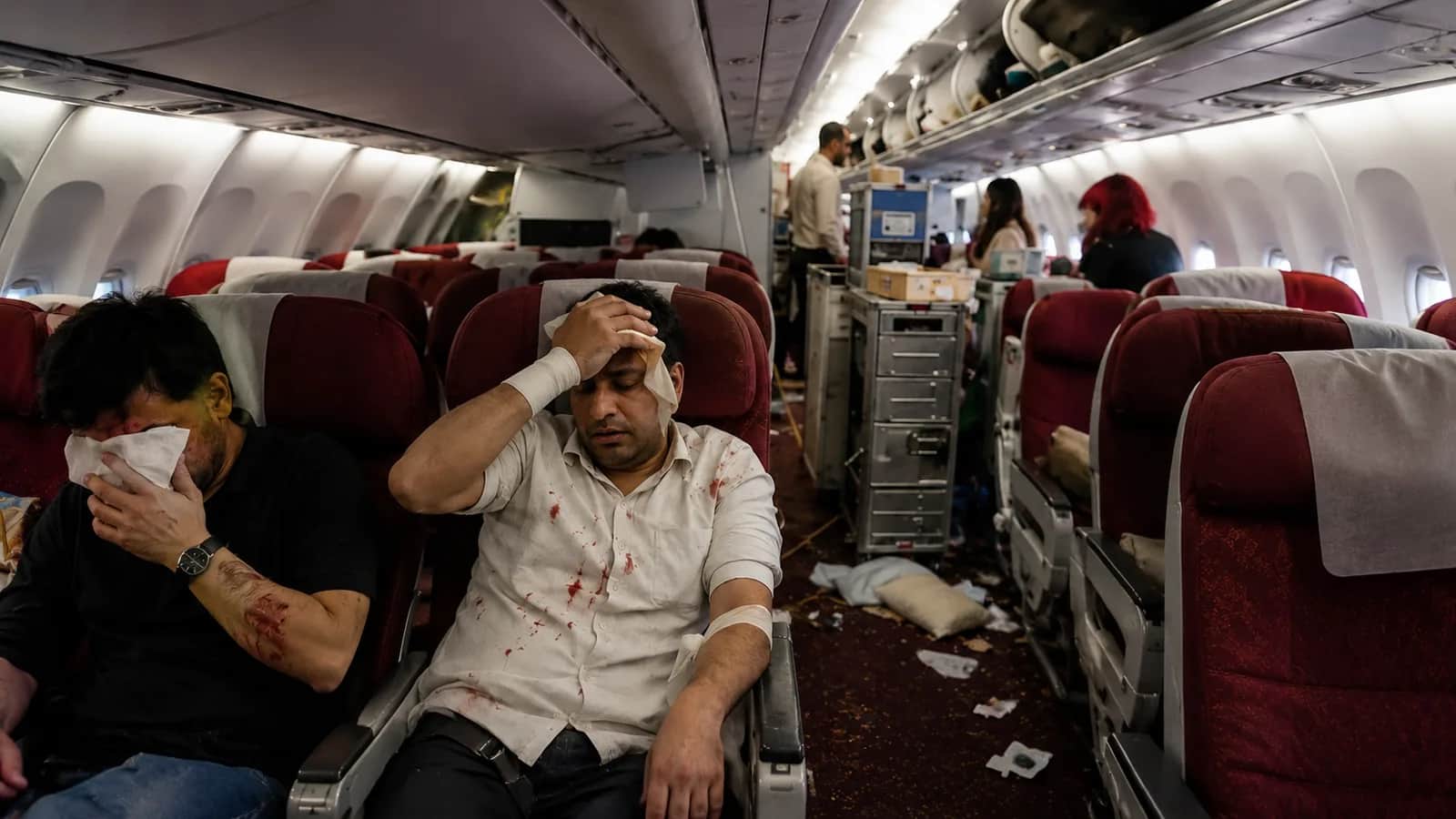
The Air India flight operating between Phuket to Delhi was subjected to severe turbulence leading to a loss of around 300 feet of the aircraft altitude resulting in 17 injured passengers and crew members – 13 passengers and four crew members. This incident has yet again brought into the limelight the issue of turbulence, why does an aircraft suddenly lose its altitude, and the danger involved in such an occurrence.
The flight AI2379 was operating on an Airbus A320neo aircraft with the registry number VT-EXO. The particular Airbus in question is an Airbus A320-251N which is an around eight years old narrow body passenger aircraft.
The flight was carrying 137 passengers and eight crew members, as per reports in The Indian Express. The flight took off from Phuket around 8:41 am and was cruising at an altitude of around 36,000 feet when the turbulence took place.
What took place on board the aircraft?
The turbulence was intense enough to create a drop of about 300 feet. Passengers not buckled up may have been slammed up into the air or against the seats as well as overhead compartment when there is sudden vertical motion for an airplane.
Following the incident, injured passengers and crew were examined at the airport and were later admitted to various hospitals such as Fortis Hospital and the Indian Spinal Injuries Center. It was reported that the aircraft’s flight data recorder and cockpit voice recorder were recovered and the Directorate General of Civil Aviation started the investigation into the incident.
According to Air India, it was an episode of turbulence which led to a temporary change in altitude. Most importantly, the aircraft landed safely.
Why then, did the Air India aircraft drop unexpectedly?
Until the official cause is determined, it will be wrong to blame the pilots, the plane or even a specific weather condition. One possibility in such cases is clear-air turbulence (CAT). Unlike turbulence that accompanies a huge visible thunderstorm, clear-air turbulence may occur under seemingly clear sky conditions and could even be undetectable by conventional onboard weather radar.
Turbulence, basically, results from an airplane passing through an area of disturbed or changing air flow. India’s National Aviation Safety Plan lists the main causes of turbulence which include, among others, changes in wind speed or direction, jet streams, thunderstorms and weather fronts.
Sharp changes in updrafts or downdrafts could lead to changes in forces that act on an aircraft. The passengers in the aircraft could perceive this situation as ‘falling’ of the plane although the aircraft itself is still under control.
At cruise level, one more important cause of turbulence is the jet stream – a narrow band of extremely high-speed air at high atmospheric levels. Large differences in wind speeds in the vicinity of jet streams lead to wind shear and turbulence.
Does this mean that there was a threat of a plane crash?
Suddenly falling is scary, but this doesn't mean that there was a falling plane or its engines were failing. The modern commercial airliner like the Airbus A320neo can cope with high aerodynamic loading, and pilots are trained to handle turbulence.
The main threat for the passengers isn't to the plane but to themselves. An unsecured passenger will lift up from the seat and hit the ceiling, the overhead bins, or other passengers.
That's why aviation authorities advise passengers to keep seat belts on even if the 'seat belt sign' is turned off. It is claimed by the FAA that wearing seat belts is one of the most efficient ways to avoid injuries caused by unexpected turbulence.
Turbulence accidents in India – how frequent are they?
Here the differentiation between an accident, incident, and turbulence encounter is important. There are thousands of encounters with turbulence every year, but there are just a few cases where the turbulence led to injury sufficient to be called an accident.
There is not any single official DGCA data on all the turbulence encounters that happened in India within the last 10 years, which means that claiming a certain number of "turbulence accidents happened in 10 years" without specifying the category is misleading.
Nevertheless, the National Aviation Safety Plan 2024-2028 issued by the DGCA includes a crucial official statistic: according to it, from 2018 till 2022 four accidents related to Indian scheduled airlines and caused by turbulence occurred; passengers and crew got injured, and one passenger died from the injuries received in turbulence in 2022.
In this context, it is essential to differentiate between an accident, incident and a turbulence encounter. There are thousands of encounters with turbulence every year. However, only a small percentage leads to injuries of such severity that it can be qualified as an accident.
No DGCA data are publicly available on all turbulence encounters in India over the last 10 years. Hence, stating “a certain number of ‘turbulence accidents happened in 10 years’ without providing an explanation of what we mean by this type of accident would be incorrect.
Nevertheless, an important DGCA figure can be found in the National Aviation Safety Plan 2024-2028 document. This plan states that there were four turbulence-related accidents in India involving scheduled Indian airlines from 2018 to 2022 when passengers and crews were injured. One passenger even died due to injuries from the turbulence encounter in 2022.
Some turbulence events that occurred within the last decade or so have been:
- April 2018 – Air India AI462: A Boeing 787 Dreamliner flying between Amritsar and Delhi had experienced severe turbulence for several minutes. There were three injured passengers, and the interior window panel fell off.
- June 2019 – IndiGo 6E5987: An Airbus A320neo on route from Mumbai to Allahabad experienced turbulence when food services were being provided. This resulted in minor injuries of three cabin crew members.
- June 2021 – Vistara Mumbai-Kolkata: A Boeing 737-800 plane which had 113 passengers onboard experienced severe turbulence close to landing in Kolkata. Eight passengers got injured, with three of them needing hospitalization. The DGCA classified this as an incident and investigated it.
- May 2022 – SpiceJet Mumbai-Durgapur: A Boeing 737 plane had severe turbulence on descent toward Durgapur. The incident received particular attention since a passenger who had been severely injured died. The safety plan of DGCA has specifically pointed out a fatality due to turbulence in 2022.
- August 2026 – Air India AI2379: A recent experience between Phuket and Delhi in an Airbus A320neo resulted in 13 injured passengers and four injured crew members after a drop of approximately 300 feet in altitude.
However, these should not be considered as a comprehensive 10-year statistical list since air transportation departments define incidents differently and some encounters with turbulence do not qualify as an accident in their definition.
Is turbulence becoming a common cause of accidents?
Indeed, there are reasons for aviation regulators to be concerned about this issue. The National Aviation Safety Plan of India says that during the period from 2018 to 2022, the proportion of turbulence-related accidents among all accidents with scheduled flights on the global air transport market has increased from 14% to 38%. That is why DGCA considers turbulence to be an aspect where more safety measures are needed, in particular, better training of flight crews and new technologies for turbulence detection.
Scientists have also started investigating if climate change may lead to more cases of clear-air turbulence as it may affect temperature changes and wind shear at high altitude levels. However, a single turbulence case cannot be immediately associated with climate change.
What now?
Investigations of the AI2379 accident will be crucial since it will allow investigators to look at the flight data recorder, cockpit communications, weather data, speed and altitude variations, as well as operational actions of the crew, and build an understanding of what happened.
As for the moment, there are no signs that there was some engine malfunction or structural problem on board the Airbus A320neo. It remained under control and landed safely.
This accident proves that turbulence still remains one of the most unpredictable factors in commercial aviation. For passengers, the easiest and most effective solution to the problem is just to keep the seat belt fastened while seated.
"The Air India flight operating between Phuket to Delhi was subjected to severe turbulence leading to a loss of around 300 feet of the aircra…"