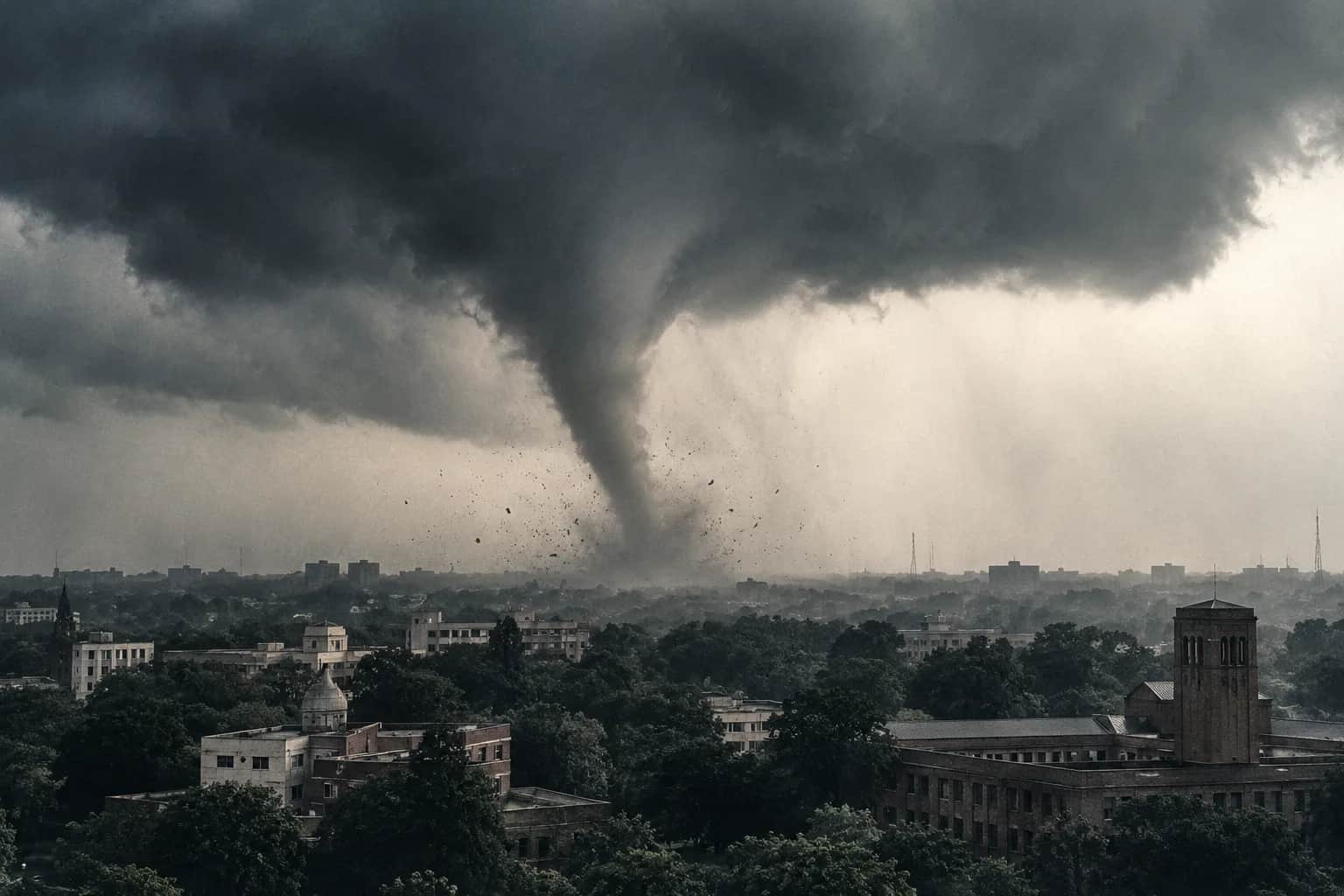
On the evening of 17 March 1978, a tornado swept through North Delhi, leaving behind a trail of destruction that the city would take years to fully understand. Lasting barely three minutes, the storm claimed 28 lives, injured around 700 people and damaged property worth more than Rs 10 million. What unfolded that evening was one of the most unusual and devastating weather events in the history of the national capital.
The tornado struck the northern parts of Delhi, particularly the areas around Delhi University's North Campus. Its path cut through residential neighbourhoods, educational institutions, public infrastructure and military barracks. For a city more accustomed to dust storms and seasonal thunderstorms, the scale and intensity of the destruction were extraordinary.
When two storms came together
According to the meteorological study published by H. N. Gupta and S. K. Ghosh in the journal Mausam in 1980, the conditions that led to the tornado developed through the interaction of two cumulonimbus cloud cells approaching from different directions.
As the two storm cells converged, they combined into a single, more powerful system. A funnel-shaped cloud then emerged from its base, producing the tornado.
The storm struck at approximately 6:05 pm Indian Standard Time. It lasted for about three minutes, but its impact extended across a stretch of nearly five kilometres.
An eyewitness account recorded in the meteorological study also mentioned the sighting of a ball of fire. The paper separately refers to an explosion-like sound, described as resembling the movement of military tanks. These were observations made during the incident; the scientific explanation documented by the researchers centred on the development and interaction of the storm cells.
Amitav Ghosh, who was then a postgraduate student at Delhi University, also witnessed the tornado. He later revisited the incident in his 2016 book The Great Derangement: Climate Change and the Unthinkable, reflecting on the extraordinary weather event and the destruction it left behind.
A five-kilometre trail of destruction
The tornado followed a path approximately five kilometres long and around 50 metres wide. It began near a nursery close to Roshanara Gardens and moved through Kamla Nagar, Birla Spinning and Weaving Mills, Maurice Nagar, Patel Road and the university area before reaching Mall Road.
It then passed the All India Radio transmitting station and the military barracks on Probyn Road before crossing the Najafgarh drain. On the other side, the DTC workshop on Banda Bahadur Marg and the Seva Kutir orphanage in Hakikat Nagar were among the places affected.
The researchers noted that almost all the damage occurred east of the Najafgarh drain. Based on the destruction observed, they indirectly estimated the maximum wind speed to have been between 113 and 157 miles per hour, or approximately 181 to 251 kilometres per hour.
The destruction began near Roshanara Gardens, where a fire engine stationed at the fire station was forced out of its shed and thrown against the nearby police station.
In Kamla Nagar, the hands and glass of the clock at the Clock Tower were damaged. At Birla Spinning and Weaving Mills, the roofs of the Blow Room and Automatic Weaving Section collapsed, injuring workers. The boundary wall of Birla Higher Secondary School also came crashing down, killing a boy.
Maurice Nagar witnessed some of the most disturbing scenes. A DTC bus was pushed into another bus, while three other buses overturned. At Daulat Ram College, the building, equipment and furniture suffered extensive damage. An elderly man sitting at a tea shop outside the college was killed, while several others were injured.
The boundary wall of Shri Ram College of Commerce collapsed, and the roof above the staircase of its hostel was blown away.
The university campus bears the brunt
The tornado continued towards Patel Road and the surrounding university institutions. At Patel Chest Institute, the front portion of the building caved in, windows were smashed and steel fencing was blown away. Medical equipment and desert coolers were destroyed.
The damage extended to Patel Niwas, where doors, windows and walls came tumbling down. The roof of the Monkey House at Patel Chest Institute was also blown away.
At Miranda House, the compound walls collapsed. SGTB Khalsa College's out-house roofs were blown off, while the main college building suffered extensive damage. Its glass panes were damaged, metal grills were wrenched out of walls, water coolers were flung into the compound and laboratory equipment was severely affected.
The researchers estimated the damage to Khalsa College at around Rs 30 lakh. The total loss across the university was estimated at more than Rs 70 lakh.
The storm's force was also evident on Mall Road. A private bus carrying approximately 70 passengers towards Panipat was lifted off the road and deposited nose-down in a nullah around 20 metres away. Two passengers were killed.
Another bus near Khalsa College, which had been standing on the road, was turned through 90 degrees. A rickshaw was lifted and thrown against a tree, while cars were displaced from the road and deposited inside the college premises.
A tea stall near the petrol pump in front of the International Students Hostel was lifted by the storm. A tempo was thrown approximately 100 metres away from the petrol pump, while its cash box was carried several hundred metres away.
The All India Radio transmitting station also suffered damage. A medium-wave transmitter tower, which had been installed around four decades earlier, collapsed, while the top of another tower was severely damaged.
Twelve deaths in Probyn Road, 80 hutments destroyed
The military barracks on Probyn Road were among the worst-affected locations. The roofs of almost all the houses in the barracks were blown away. Twelve people lost their lives there.
Beyond the Najafgarh drain, the DTC workshop on Banda Bahadur Marg suffered substantial damage. The entire roof of Seva Kutir, an orphanage in Hakikat Nagar, collapsed, trapping several children beneath the debris.
The destruction was not limited to institutional buildings. Around 80 hutments along the southern boundary wall of the DTC workshop were completely destroyed, injuring many of their occupants.
The meteorological report also recorded the discovery of a headless body in a ditch. The account offers a stark indication of the violence with which the tornado swept through the area.
The morning after: Rajesh Kapoor's photographs
The morning after the tornado offered a clearer picture of the destruction left behind. Rajesh Kapoor, a resident of Probyn Road, documented the aftermath through photographs and personal recollections.
His photographs captured the unusual positions in which vehicles had been left by the storm, including an overturned Ambassador car and a bus inside the premises of Khalsa College. The images also recorded damage to public infrastructure around the affected areas.
Kapoor's photographs and recollections provide a visual record of the aftermath, complementing the meteorological survey conducted by the researchers. They also help preserve details of an event that has gradually faded from the city's collective memory.
A tornado surrounded by Delhi's folk
Beyond the scientific explanation, the 1978 tornado also became the subject of several unusual stories. Over the years, accounts circulated linking the destruction to an unidentified flying object or an aircraft with extraordinary capabilities.
Another local story connected the incident to a shrine and the grave of a holy man near Probyn Road. Such explanations became part of the folklore surrounding the tornado, although none was established by the meteorological investigation.
The contrast between these stories and the scientific findings is striking. While the IMD researchers documented the interaction of storm cells and the formation of a funnel cloud, the scale of the destruction left room for speculation among those who witnessed or heard about the event.
The Storm Delhi Almost Forgot: A Memory That Faded With Time
In their 1980 study, Gupta and Ghosh classified the tornado as F2 P2 P2 on the Fujita-Pearson scale. Their report placed the death toll at 28, the number of injured at around 700 and the property damage at slightly more than Rs 10 million.
The researchers described it as, to their knowledge, the first tornado recorded in the capital of India.
Nearly five decades later, the incident remains an extraordinary chapter in Delhi's weather history. Its route can still be traced through the places documented in the meteorological survey: from Roshanara Gardens and Kamla Nagar to Maurice Nagar, Mall Road, Probyn Road and the areas beyond the Najafgarh drain.
The three-minute storm left behind collapsed walls, damaged institutions, destroyed homes and hundreds of injured people. Its memory survives in scientific records, photographs and personal recollections. Yet, outside these accounts, the tornado of 17 March 1978 remains an event that much of Delhi has forgotten.
"On the evening of 17 March 1978, a tornado swept through North Delhi, leaving behind a trail of destruction that the city would take years t…"