
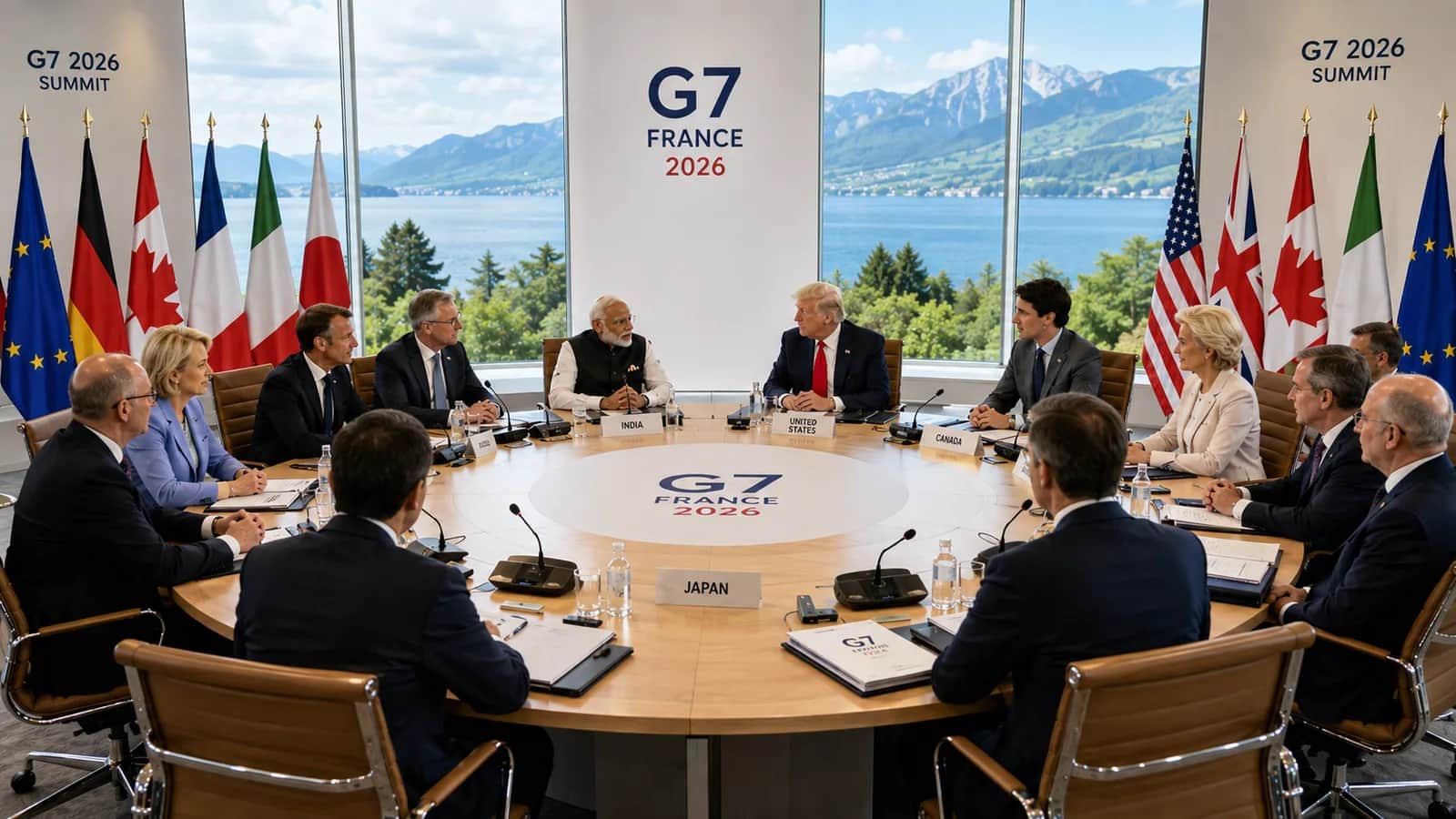
The 52nd G7 Summit in Évian-les-Bains, France, took place against the backdrop of escalating geopolitical tensions, economic uncertainty, and technological transformation. While discussions ranged from the Ukraine war and the Iran crisis to artificial intelligence and global economic stability, one of the strongest messages came from Prime Minister Narendra Modi, who called for the protection of maritime routes and the safety of seafarers following the deaths of three Indian mariners in a recent US military strike in the Gulf of Oman.
Addressing the G7 Outreach Session, Modi stressed that the world today suffers not from a shortage of resources but from a shortage of trust. He urged nations to ensure that sea lanes remain open and secure, allowing seafarers to perform their duties without fear. The remarks came days after three Indian crew members were killed amid rising tensions in the Gulf region. Modi also reiterated India's position that dialogue, diplomacy, and international cooperation remain the only sustainable path to resolving conflicts.
Strait of Hormuz and Global Economic Concerns
A major concern at the summit was the security of the Strait of Hormuz, one of the world's most important maritime chokepoints. Nearly 20 percent of global oil trade passes through this narrow waterway connecting the Persian Gulf to international markets. Any disruption in the region directly affects oil prices, shipping costs, and inflation worldwide. G7 leaders discussed the economic fallout of tensions involving Iran and the need to maintain the free flow of energy supplies.
For India, the issue carries particular significance. The country imports more than 85 percent of its crude oil requirements, with a substantial share passing through the Gulf region. Rising instability threatens both India's energy security and broader economic growth.
Ukraine War Remains a Central Focus
The ongoing Russia-Ukraine war dominated discussions among G7 leaders. Ukrainian President Volodymyr Zelenskyy attended the summit and sought stronger military assistance, additional sanctions on Russia, and greater support for air defence systems. Several leaders discussed possible diplomatic pathways to peace while maintaining pressure on Moscow through economic measures.
Artificial Intelligence and Economic Stability
Beyond geopolitical conflicts, the summit focused heavily on artificial intelligence and the future of the global economy. Leaders examined the opportunities and risks associated with rapid AI development, including regulation, digital governance, cybersecurity, and the protection of children online. Discussions also addressed concerns over slowing global growth, supply-chain vulnerabilities, debt burdens in developing nations, and international economic imbalances.
India's Global South Agenda
Participating in the summit as an invited partner, India emphasized the concerns of developing nations. Ahead of the summit, Modi stated that India would not only represent its own interests but also serve as a voice for the Global South. Issues such as energy security, sustainable development, climate resilience, technology access, and equitable economic growth formed key elements of India's engagement.
A Call for Cooperation in a Fragmented World
As conflicts in Europe and the Middle East continue to test international institutions, the G7 Summit highlighted the growing need for global cooperation. Modi's call for secure maritime routes and diplomatic solutions reflected a broader concern shared by many nations: that geopolitical rivalries must not disrupt global trade or endanger civilian lives. In a world increasingly shaped by conflict, technological change, and economic uncertainty, the summit underscored the importance of trust, dialogue, and collective action in addressing shared challenges.
"The 52nd G7 Summit in Évian-les-Bains, France, took place against the backdrop of escalating geopolitical tensions, economic uncertainty, an…"