
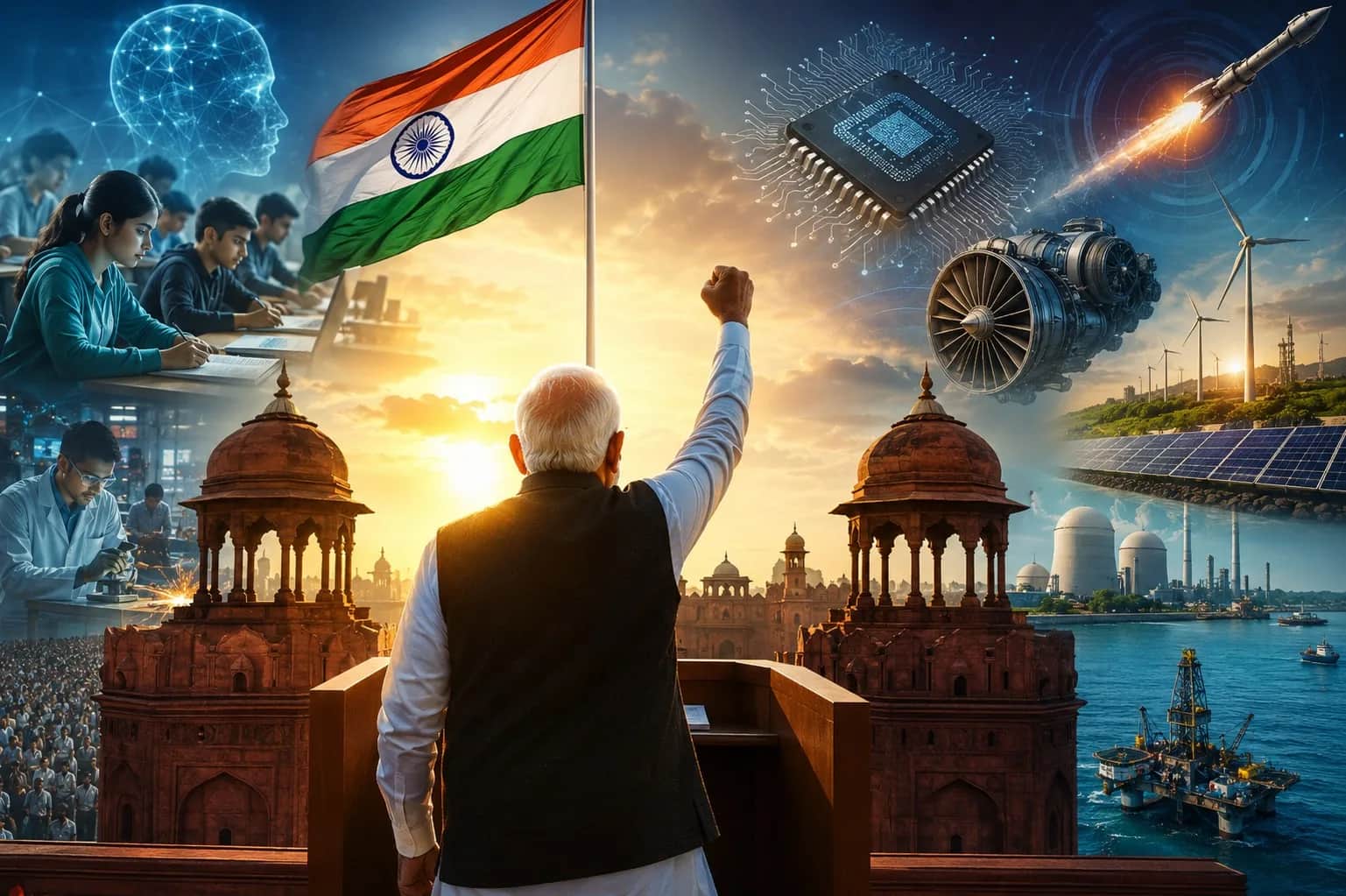
In a speech delivered from the Red Fort on Independence Day, the Prime Minister today announced a comprehensive set of plans covering employment, technology, energy and national security. The speech touched on nearly every part of daily life, from how young people will be trained for the future to how the country plans to cut its dependence on imported energy and chips. Several of the announcements come with clear numbers and timelines attached, which is unusual for a speech that is often remembered more for its tone than its specifics. This year, the government appears keen to show that big promises also come with big budgets, whether that is the ₹1 lakh crore employment scheme or the plan to raise nuclear power capacity tenfold by 2047. The announcements suggest a government trying to move on several fronts at once, betting heavily on the country's young population to drive the next phase of growth.
Youth Employment and AI Skilling at the Core
One aspect of this speech that stood out was the importance the government gave to young Indians being prepared for an evolving job market. For this reason, an Artificial Intelligence training programme on a national scale for one crore youth was planned by the government in the coming year, which means that this programme would be executed through schools, colleges, and probably private partners as well. In addition to this, PM Viksit Bharat Rozgar Yojana worth ₹1 lakh crore has been announced. Under this yojana, youth joining the private sector will be given a monthly aid of ₹15,000 and it has been estimated that around 3 to 3.5 crore citizens will benefit from this scheme.
Free Online Coaching to Ease Exam Pressure
Recognising how much money families spend on coaching classes for competitive exams, the government announced a free digital coaching ecosystem meant to support students preparing for these tests. The idea is to reduce the financial strain on middle-class and poor households who often stretch their budgets to afford private coaching. While details on how this digital platform will function are still to be worked out, the intent is clearly to make exam preparation more accessible regardless of a family's income.
Semiconductor Push and a Challenge on Jet Engines
On the technology and manufacturing side, the government spoke about Semicon 2.0, a plan to build between 5 to 8 new semiconductor plants over the next seven to eight years. The goal is to give India an end-to-end chip making capability instead of relying on imports for critical components. The PM also issued a direct challenge to Indian scientists and young engineers to design and manufacture homegrown jet engines, a sector where India has historically depended on foreign technology.
Innovation Funding and Tax Reforms for MSMEs
Beyond jobs, the government set aside a separate ₹1 lakh crore fund specifically to support ideas, research projects and startups led by young innovators. This is meant to work alongside the employment scheme rather than compete with it, giving entrepreneurial youth a distinct pool of funding to draw from. On the tax front, the government confirmed that Next-Gen GST reforms are planned before Diwali, with the stated aim of lowering taxes on everyday essential items. This is expected to help both consumers and small and medium enterprises (MSMEs), who often bear the brunt of complicated tax structures. To carry these reforms forward, a Reform Task Force will be set up to implement strategic economic changes with the long-term target of pushing India toward a 10 trillion-dollar economy by 2047.
Nuclear and Deepwater Missions for Energy Independence
Energy security was also featured prominently in the address. The government announced that it will open up the nuclear sector to private firms, with the aim of increasing India's nuclear power capacity tenfold by 2047. This marks a significant shift from the current model, where nuclear power generation has largely stayed within government control. Alongside this, a National Deepwater Exploration Mission was announced to tap into ocean resources, and this will run alongside stronger pushes in solar, hydro and hydrogen energy. The combined goal across all these efforts is full energy independence for the country.
Mission Sudarshan Chakra and the Demography Task Force
On national security, the PM unveiled Mission Sudarshan Chakra, described as a modernised defensive weapon system meant to protect critical national infrastructure, with a target completion date of 2035. The speech also addressed concerns around illegal immigration and infiltration in border regions, announcing a High-Powered Demography Mission that will work as a dedicated structural body to address demographic imbalances linked to these issues.
Olympic Talent Hunt and Historic Vande Mataram
The address also made room for sports and culture. A nationwide Olympic Talent Hunt was announced, with the goal of identifying, tracking and training sporting talent in children between the ages of 5 and 15, with an eye on building future Olympic champions over the coming years. A moment that stood out for its symbolism was the full rendition of Vande Mataram was performed and echoed across the Red Fort event, marking the first time this has happened at an Independence Day function since the country gained independence. With announcements spanning technology, jobs, energy and security, this year's address leaned heavily on numbers and deadlines, giving the public a fairly detailed roadmap to track in the years ahead. Whether these plans translate into results on the ground will likely become clearer as implementation details are released in the coming months.
"In a speech delivered from the Red Fort on Independence Day, the Prime Minister today announced a comprehensive set of plans covering employ…"