
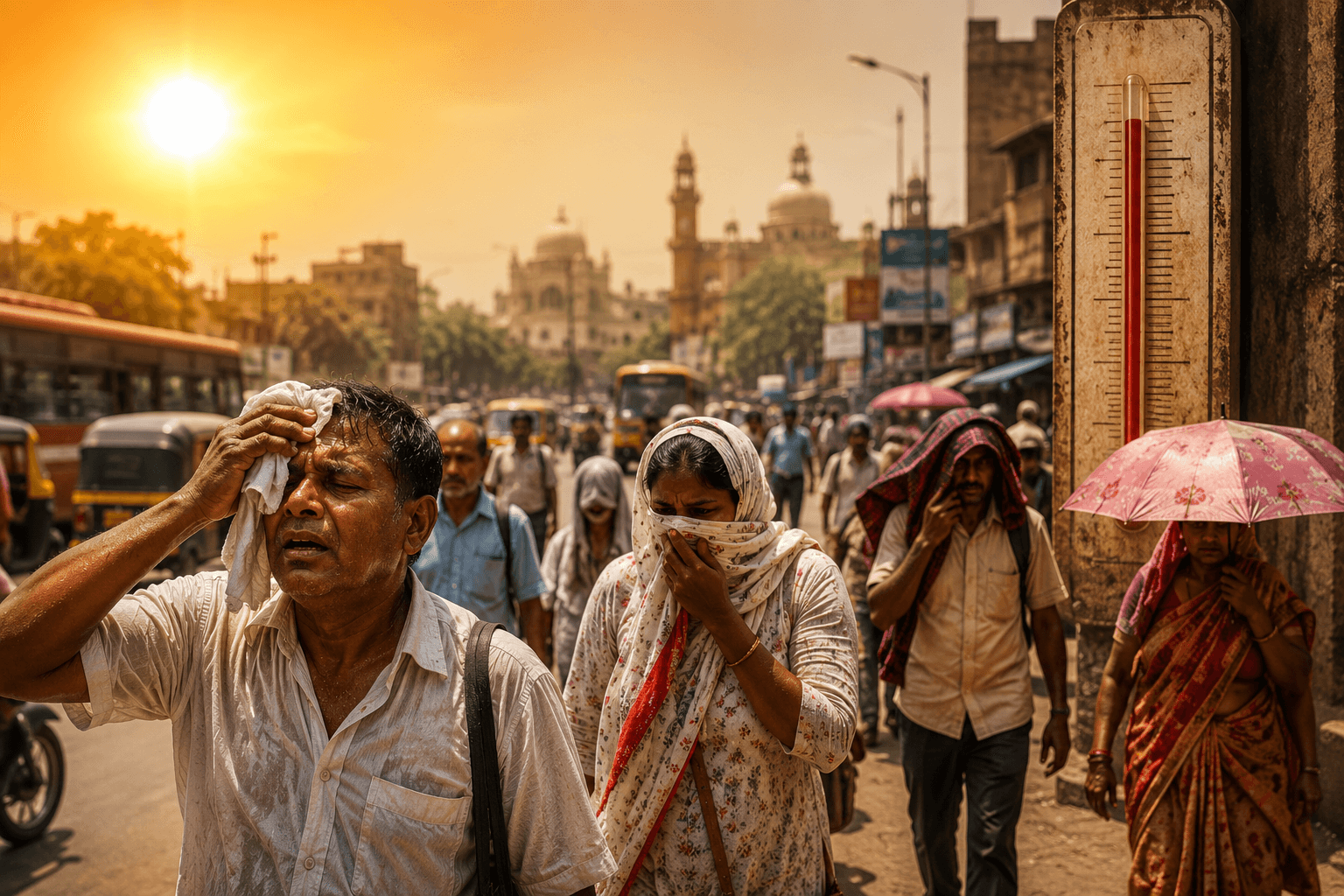
World Environment Day brings universal focus back to environmental problems like climate change and global warming universally and the recent research from the University of Oxford has identified 14 cities in India among the world's top 50 facing significant heat risk.
Ahmedabad ranks among the most heat-exposed urban centres in India, Nagpur in 4th position and Madurai in 7th position are also placed high in the risk ranking.
India’s 14 Cities in Global Heat Risk List
According to the Oxford study, Nagpur ranked fourth globally among the cities assessed for heat risk, while Madurai ranked seventh and Ahmedabad also featured among the highest-risk urban centres.
According to reports, Researchers warn that these major urban centres must urgently pivot toward structural urban reform to survive the compounding impacts of climate change.
Cities on the Frontline
Published in the journal Sustainable Cities and Society, the study evaluates urban heat risk based on three key indicators:
- Heat hazard exposure
- Population vulnerability
- Adaptive and coping capacity
Al Basrah (Iraq) is among the most heat-vulnerable cities globally. More than 95% of high-risk cities are located in South & Southeast Asia and Sub-Saharan Africa.
Countries most affected include India, Pakistan, Nigeria, and Ghana.
India stands out as one of the nations with the highest number of vulnerable cities.
Experts say
Lead author Nethmi Jayaratne Kariyawasam from the Oxford Smith School of Enterprise and the Environment stated,
“It isn’t just exposure to high temperatures that matters for risk. Our study emphasizes the need for multi-faceted global heat risk assessments that reveal the various pathways through which urban heat risk develops."
Radhika Khosla, Associate Professor at the University of Oxford and co-supervisor of Nethmi’s research, stated,
Our study indicates that heat risk planning must explicitly address not only exposure to high temperatures but also vulnerability and coping capacity.
Expert raised Rising Air Conditioner Demand and Climate Cost
As extreme heat becomes more frequent, urban cooling demand is rising sharply. Increasing reliance on air conditioners is helping people cope with heat stress.
However, higher electricity consumption is driving up energy demands. Experts caution that without energy-efficient cooling systems and sustainable urban planning, heat stress will continue to intensify.
Irregular Rainfall and Weather Instability
Alongside rising temperatures, climate systems are showing increasing instability:
- Monsoon rainfall is becoming more irregular and unpredictable.
- Sudden heavy downpours are followed by prolonged dry spells.
- Large-scale shifts in wind patterns and ocean temperatures are being observed.
These disruptions are affecting agriculture, water availability, and urban infrastructure across regions.
Public Reaction
As the findings circulated, social media users expressed concern over the rising heat conditions being scientifically documented.
One widely shared reaction noted:
“We were only feeling the heat, but this report has now officially confirmed it.”
With World Environment Day 2026 underscoring the urgency of climate action, the study reinforces a critical reality, extreme heat is no longer a distant warning but a present and escalating urban crisis.
With India featuring heavily in global heat-risk rankings, the need for climate-resilient cities, sustainable cooling systems, and urgent environmental policy action has become more urgent than ever.
"World Environment Day brings universal focus back to environmental problems like climate change and global warming universally and the recen…"