
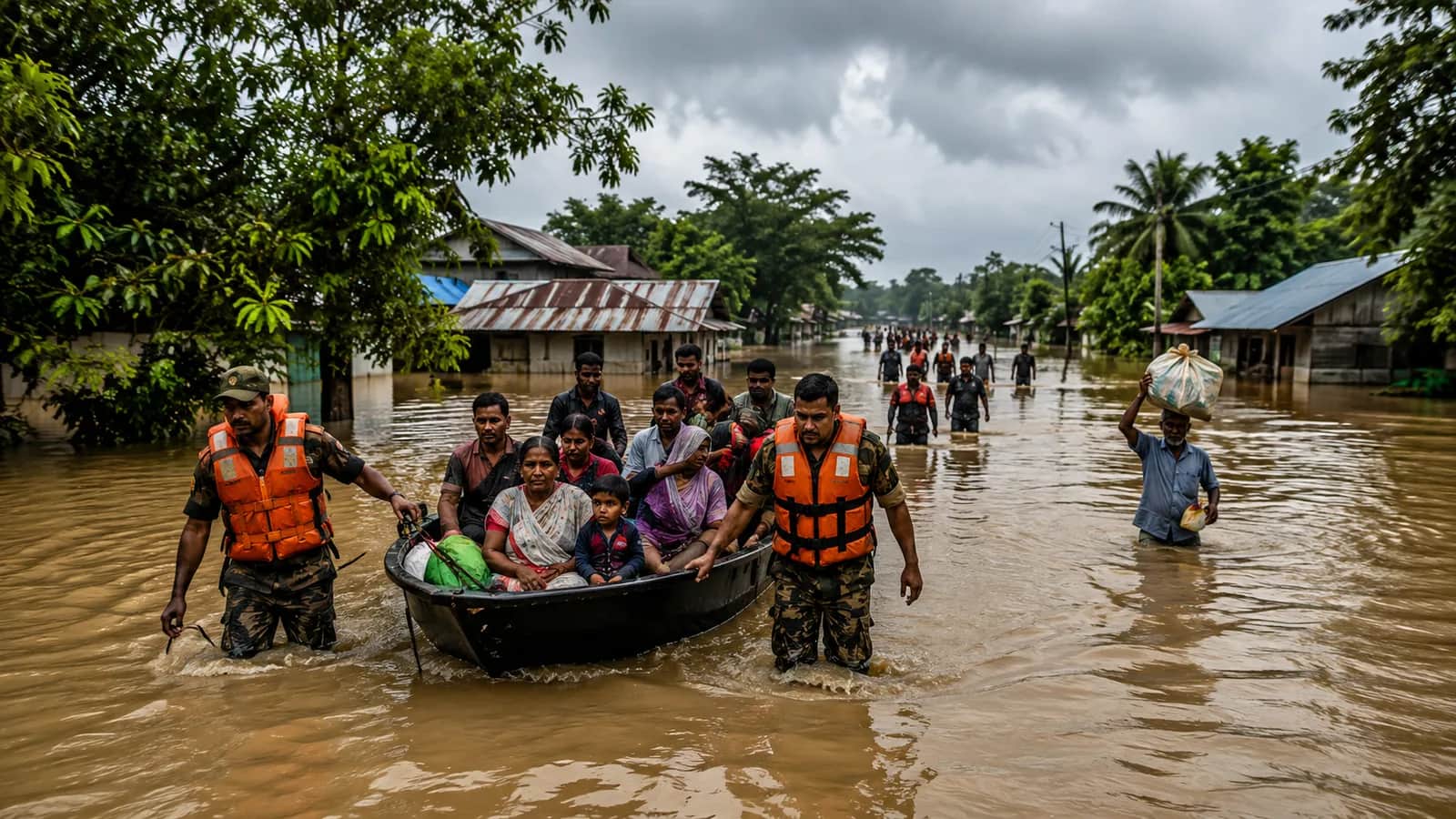
Assam once again finds itself amidst its worst ever flood disaster, as the condition becomes worse by the day. According to official sources, over 1.6 lakhs of people have been affected in 14 districts, whereas the death toll stands at 95, as six more deaths were reported on Wednesday.
The recent deaths were reported from Sivasagar, Biswanath, Golaghat, and Morigaon districts. While Sivasagar became the most affected district by reporting 50 deaths, neighboring Charaideo witnessed 21 deaths. Other districts that reported casualties include Jorhat, Golaghat, Dhemaji, Karbi Anglong, Sonitpur, Kamrup Metropolitan, and Morigaon.
More than 1,60,600 people remain affected in districts like Biswanath, Charaideo, Darrang, Dhemaji, Golaghat, Jorhat, Kamrup Metropolitan, Karbi Anglong, Lakhimpur, Nagaon, Sivasagar, Sonitpur, Tinsukia and Udalguri, with Sivasagar reporting more than 57,000 affected people.
The government has established more than 100 relief camps and distribution centers where more than 44,500 displaced individuals have been provided with shelter. About 17,000 hectares of land used for agriculture is still underwater, whereas there is significant damage to roads, bridges, embankments and other forms of public infrastructure.
While visiting the heavily flooded Nepalikhuti village in the Sivasagar district, India’s Union Health Minister J.P. Nadda, who has been sent on a mission by Prime Minister Narendra Modi to inspect the flood situation in the region, declared the damage to be “enormous” and promised all necessary help from the Central government to the flood victims.
Why Does Assam Suffer from Floods Every Year?
Floods in Assam are not a recent occurrence. Assam is part of the Brahmaputra River Basin, which is the largest and one of the most active river basins in the world. Every year, the rivers flowing through the region receive large quantities of water due to rains in Assam, Arunachal Pradesh, Bhutan and Tibet.
There are several reasons why floods occur in Assam:
- The Brahmaputra has one of the highest amounts of sediment load in the world. Sediments of sand and silt get deposited on the river bed making the channel narrow and decreasing its water carrying capacity and thus causing flooding during heavy rainfalls.
- The rains of the monsoons are intense in the foothills of the Himalayas, increasing the discharge of the rivers at an incredibly fast rate, which is sometimes only a matter of hours.
- Deforestation and hillside erosion due to human activities in the upstream area deposit soil in the rivers, leading to increased siltation.
- With climate change, rainfall is unpredictable with very short intervals of intense rainfall replacing long intervals of moderate rainfall. This makes flash floods possible.
- The drainage capacity of floodplains and wetlands has been decreased by encroachment of people in the regions.
Floods form an integral component of the ecosystem in Assam; however, due to urbanization and climate change along with additional stress being laid on rivers, floods have become more disastrous.
While floodwater keeps wreaking havoc on many lives, immediate attention is being given to rescue, relief and rehabilitation efforts. However, it is imperative for experts that some other long term measures are taken in order to address the frequent floods in Assam.
"Assam once again finds itself amidst its worst ever flood disaster, as the condition becomes worse by the day. According to official sources…"