
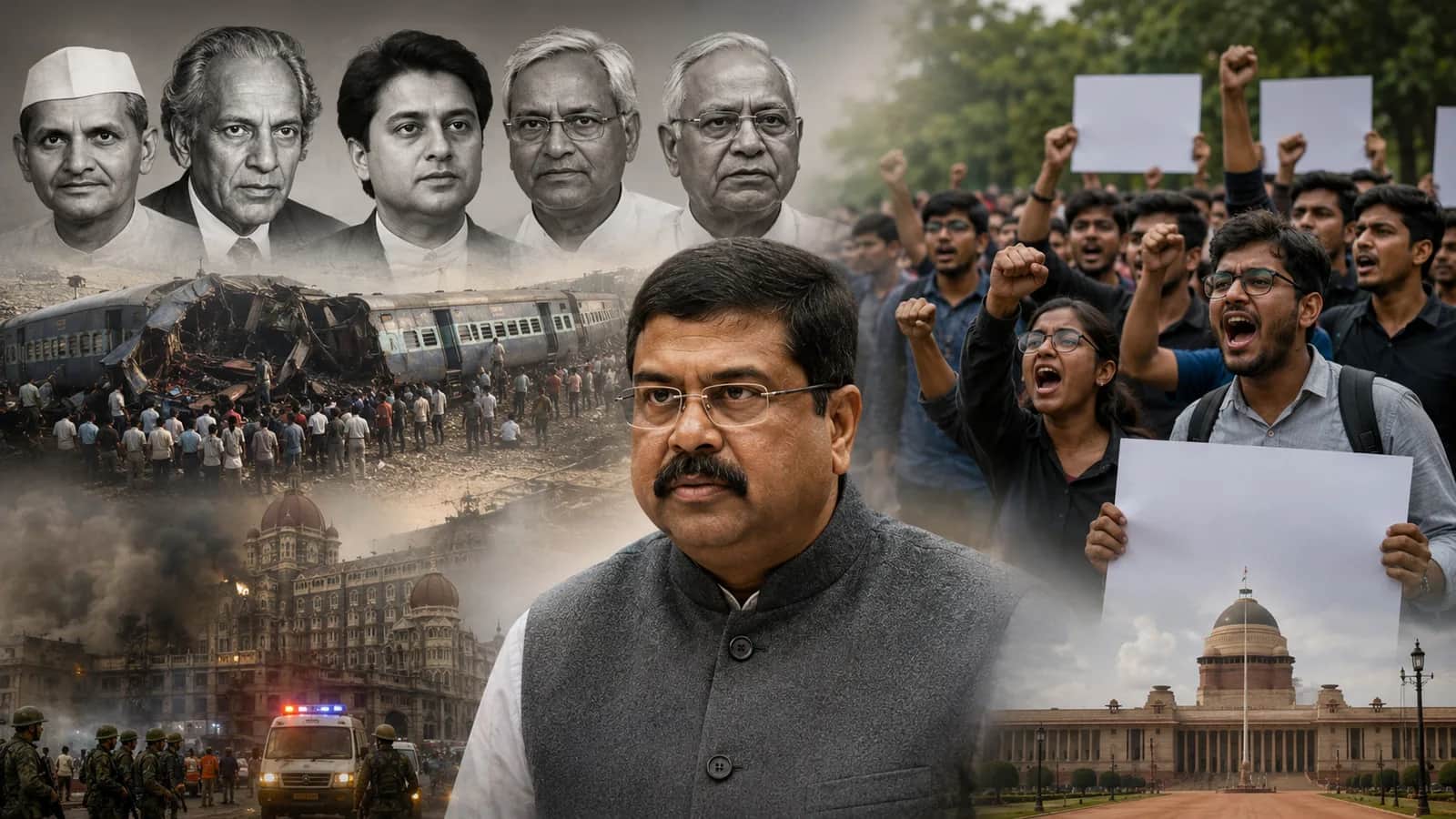
The alleged NEET paper leak did more than trigger protests by students. It reopened a debate that has surfaced repeatedly in independent India's political history- should a minister resign when a major crisis unfolds under their watch?
For weeks, students took to the streets demanding a fair investigation and accountability. Opposition parties raised the issue inside and outside Parliament, questioning the government's handling of the examination system. One of the most visible faces of the movement was the Cockroach Janta Party (CJP), which organised demonstrations in several cities and consistently demanded the resignation of Union Education Minister Dharmendra Pradhan.
As public pressure mounted, Pradhan stepped down from the Union Cabinet, saying he was taking moral responsibility for the controversy. Whether his resignation was driven by politics, public outrage or a sense of accountability, it has once again put the spotlight on a question Indian politics has never fully answered- where does responsibility begin, and where does it end?
India has witnessed wars, deadly train accidents, plane crashes, terror attacks and corruption scandals over the past 79 years. In most cases, governments have promised reforms, ordered inquiries and announced compensation. Only on a few occasions, however, has a Union minister actually left office.
Lal Bahadur Shastri: The resignation that became a lesson in leadership
If there is one resignation that still defines political accountability in India, it is that of Lal Bahadur Shastri.
In 1956, a train accident near Ariyalur in Tamil Nadu killed more than 140 passengers. Shastri, then Railway Minister, was not accused of causing the tragedy. Even so, he believed that if the Railway Ministry had failed, its minister had to answer for it.
Prime Minister Jawaharlal Nehru reportedly wanted him to stay. Shastri refused.
His resignation wasn't forced by protests or political pressure. It was his own decision, a rare example of a leader placing accountability above office. Nearly seven decades later, it remains the benchmark against which almost every ministerial resignation is measured.
Krishna Menon: When a war changed everything
India's defeat in the 1962 war with China left the country shaken.
Questions were raised about military preparedness, intelligence failures and political decisions. Much of the criticism fell on Defence Minister V.K. Krishna Menon.
Unlike Shastri, Menon did not resign immediately. His exit came only after sustained criticism from Parliament, the Opposition and even within the Congress. It became one of the earliest examples of a minister losing office because political pressure had become impossible to ignore.
Scindia and Nitish Kumar: When ministers chose accountability
In 1993, an Indian Airlines aircraft crashed near Aurangabad, killing dozens of passengers.
Civil Aviation Minister Madhavrao Scindia resigned soon afterwards, even though no inquiry held him personally responsible. His message was simple: if people lose faith in the ministry, the minister cannot simply walk away from responsibility.
A similar moment came in 1999, when the Gaisal train collision in West Bengal claimed nearly 300 lives.
Railway Minister Nitish Kumar also resigned, saying the tragedy had happened under his ministry's watch. Like Shastri, he chose to step aside instead of waiting for demands to grow louder.
26/11 and the resignation that followed public outrage
The Mumbai terror attacks of November 2008 were one of the darkest moments in India's history.
As the country mourned the victims, questions over intelligence failures and internal security dominated the national conversation.
Home Minister Shivraj Patil faced intense criticism from the Opposition, security experts and the public. His resignation came after days of mounting pressure, making it one of the most significant political consequences of the attacks.
Not every resignation followed a tragedy
Some ministers resigned not because of disasters but because of corruption allegations, legal proceedings or political controversies.
These include T.T. Krishnamachari after the LIC-Mundhra scandal, A. Raja and Dayanidhi Maran during the 2G spectrum case, Ashwani Kumar in the Coalgate controversy, Pawan Kumar Bansal in the railway bribery case, Shibu Soren after legal proceedings, M.J. Akbar following sexual misconduct allegations and Harsimrat Kaur Badal, who left the Union Cabinet in protest against the farm laws.
A tradition that has become increasingly uncommon
Looking back, India's political history reveals two very different kinds of resignations.
Leaders like Lal Bahadur Shastri, Madhavrao Scindia and Nitish Kumar chose to leave office on their own, believing that public office carried moral responsibility.
Others including V.K. Krishna Menon, Shivraj Patil and Dharmendra Pradhan, stepped down only after public anger, sustained protests or political pressure made their position increasingly difficult to defend.
That difference matters.
Because resignations are not just about losing a minister. They reflect how governments respond when public trust is shaken.
From the Ariyalur train disaster in 1956 to the NEET controversy nearly seven decades later, the debate has remained the same. When institutions fail, people don't just ask what went wrong, they also ask who is willing to take responsibility.
"The alleged NEET paper leak did more than trigger protests by students. It reopened a debate that has surfaced repeatedly in independent Ind…"