
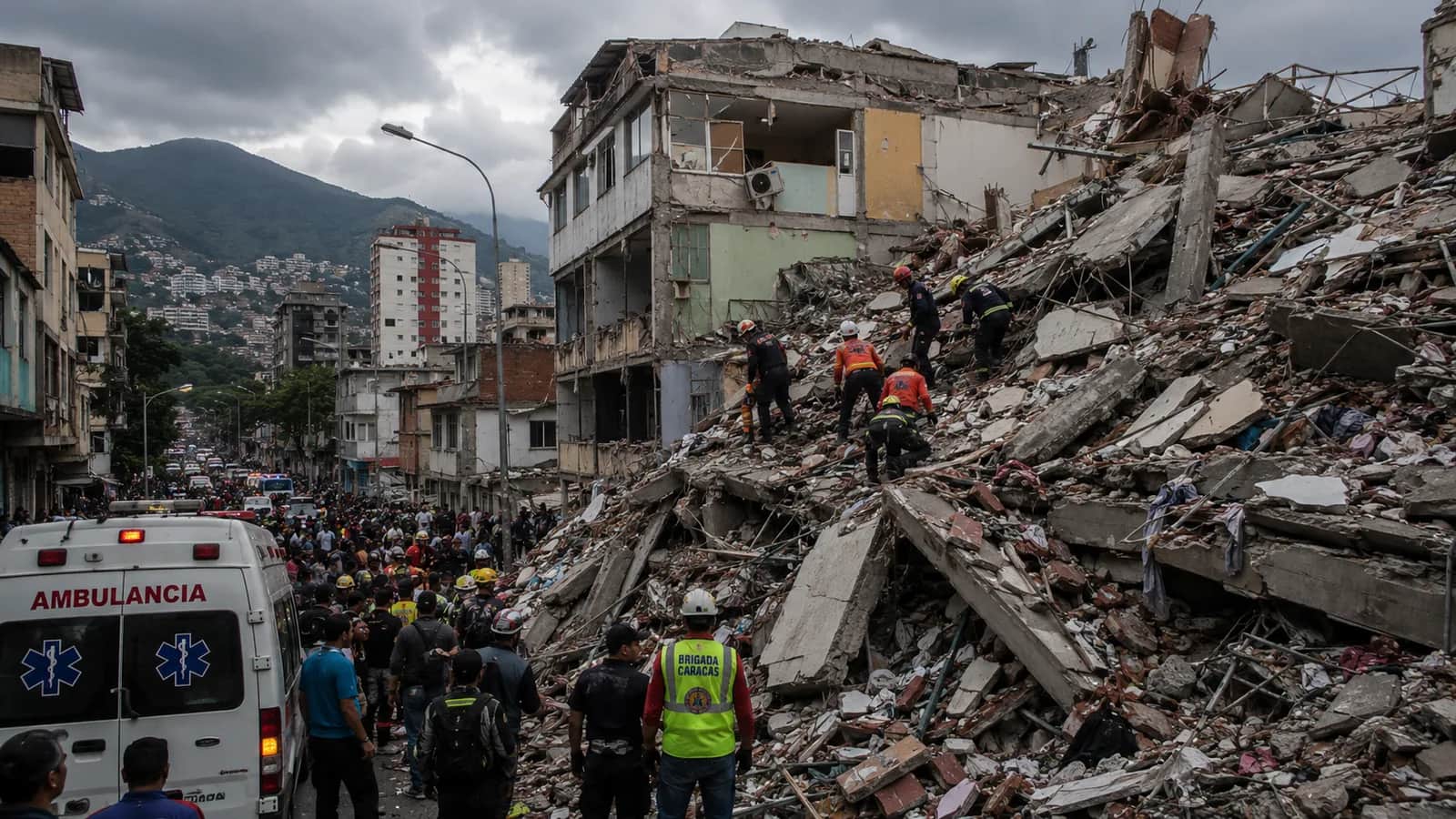
For thousands of people in Venezuela, home is no longer a place of safety.
Many families are spending their nights on roads, football grounds and open parks, too frightened to return to buildings that could collapse at any moment. Just as rescue teams continued searching for survivors beneath the rubble, the ground shook once again.
A 4.9-magnitude earthquake struck off Venezuela's northern coast on Friday, sending fresh waves of panic across Caracas, Maracay, and nearby cities. The tremor came only two days after the country was devastated by two massive earthquakes measuring 7.2 and 7.5, which struck just 39 seconds apart.
For survivors, the latest quake wasn't just another aftershock, it was a reminder that their nightmare is far from over.
The twin earthquakes on Wednesday turned bustling neighbourhoods into disaster zones within seconds. Apartment buildings crumbled, roads cracked open, hospitals suffered extensive damage, and thousands of families lost everything they had built over a lifetime.
According to the latest official figures, more than 920 people have been killed, while over 3,300 people have been injured. Rescue workers are still searching for at least 172 people believed to be trapped beneath collapsed buildings, while tens of thousands of people remain displaced. Experts fear the death toll could rise further as search operations continue.
Across the affected areas, ordinary citizens have become heroes. Neighbours are digging through piles of concrete with their bare hands, using shovels and iron rods to reach survivors. Private vehicles have been turned into makeshift ambulances, while volunteers distribute food, water and blankets to those left homeless.
Among those desperately waiting is 25-year-old Jennifer Palacios, whose six-year-old son and five other family members remain buried beneath the rubble.
"It is the community that has managed to get people out alive," she said. "We need cranes to lift the concrete slabs. There are still people trapped."
Her words reflect the heartbreak of thousands of families still hoping for a miracle.
To help people reconnect with missing loved ones, the Venezuelan government has temporarily eased restrictions on the social media platform X, allowing residents to share photographs, seek emergency assistance and coordinate rescue efforts.
Is This Venezuela's Biggest Earthquake in 100 Years?
Seismologists say the answer is yes almost.
The 2026 twin earthquakes are being described as the strongest to hit Venezuela in more than a century and the country's most destructive earthquake disaster since the powerful 1900 San Narciso earthquake.
What made this disaster exceptionally deadly was the rare phenomenon known as a "seismic doublet." Instead of one major earthquake, Venezuela was struck by two powerful earthquakes within just 39 seconds. Buildings weakened by the first shock had almost no chance of surviving the second.
Why Do Earthquakes Happen in Venezuela?
Venezuela lies along the boundary of the Caribbean Plate and the South American Plate, two massive tectonic plates that are constantly moving against each other.
Over decades, enormous pressure builds up beneath the Earth's surface. When that pressure is suddenly released, it triggers an earthquake.
The country's northern coastline, including Caracas, sits close to the San Sebastián Fault, making it one of Venezuela's most earthquake-prone regions. Although powerful earthquakes are relatively rare, scientists have long warned that the region remains vulnerable to major seismic activity.
Venezuela Has Faced Deadly Earthquakes Before
This is not the first time Venezuela has witnessed such devastation.
In 1641, a powerful earthquake destroyed much of colonial Caracas.
The 1812 Caracas earthquake, estimated at magnitude 7.7, remains the deadliest in the country's history, claiming between 15,000 and 20,000 lives.
Nearly a century later, in 1900, the San Narciso earthquake, measuring around 7.6–7.7, struck the country's northern coast and even triggered a tsunami.
The 1929 Cumaná earthquake caused widespread destruction and another tsunami, while the 1967 Caracas earthquake killed around 300 people and injured more than 1,500.
More recently, a 7.3-magnitude earthquake in 2018 shook much of northern Venezuela and neighbouring Caribbean nations. However, because its epicentre was offshore, casualties remained comparatively low.
The 2026 earthquake, however, stands apart because of its extraordinary intensity, the rare back-to-back shocks and the widespread destruction in densely populated urban areas.
India Extends a Helping Hand
As Venezuela struggles to recover, countries around the world have begun sending humanitarian assistance. India has emerged as one of the first nations to respond.
Following Prime Minister Narendra Modi's message of solidarity, India launched Operation Amistad to support earthquake-hit Venezuela.
Under the mission, the Indian Air Force dispatched two C-17 Globemaster aircraft carrying more than 35 tonnes of relief material, including medicines, emergency medical equipment and essential humanitarian supplies.
India also sent two BHISHM Cubes portable emergency medical units capable of providing life-saving treatment in disaster-hit areas.
In addition, a 41-member medical team from the Indian Army's 60 Para Field Hospital has been deployed to assist local authorities. The team includes surgeons, doctors, nursing staff and disaster-response specialists who will help treat the injured and strengthen ongoing rescue operations.
The swift response reflects India's growing role as a global first responder during humanitarian crises.
For now, however, Venezuela's biggest battle is still unfolding.
As rescue workers continue searching beneath broken concrete and families wait anxiously for news of missing loved ones, every passing hour becomes more critical.
The earth may have stopped shaking for the moment, but for millions of Venezuelans, the struggle to rebuild their homes, reunite with their families and heal from this tragedy has only just begun.
"For thousands of people in Venezuela, home is no longer a place of safety.Many families are spending their nights on roads, football grounds…"