
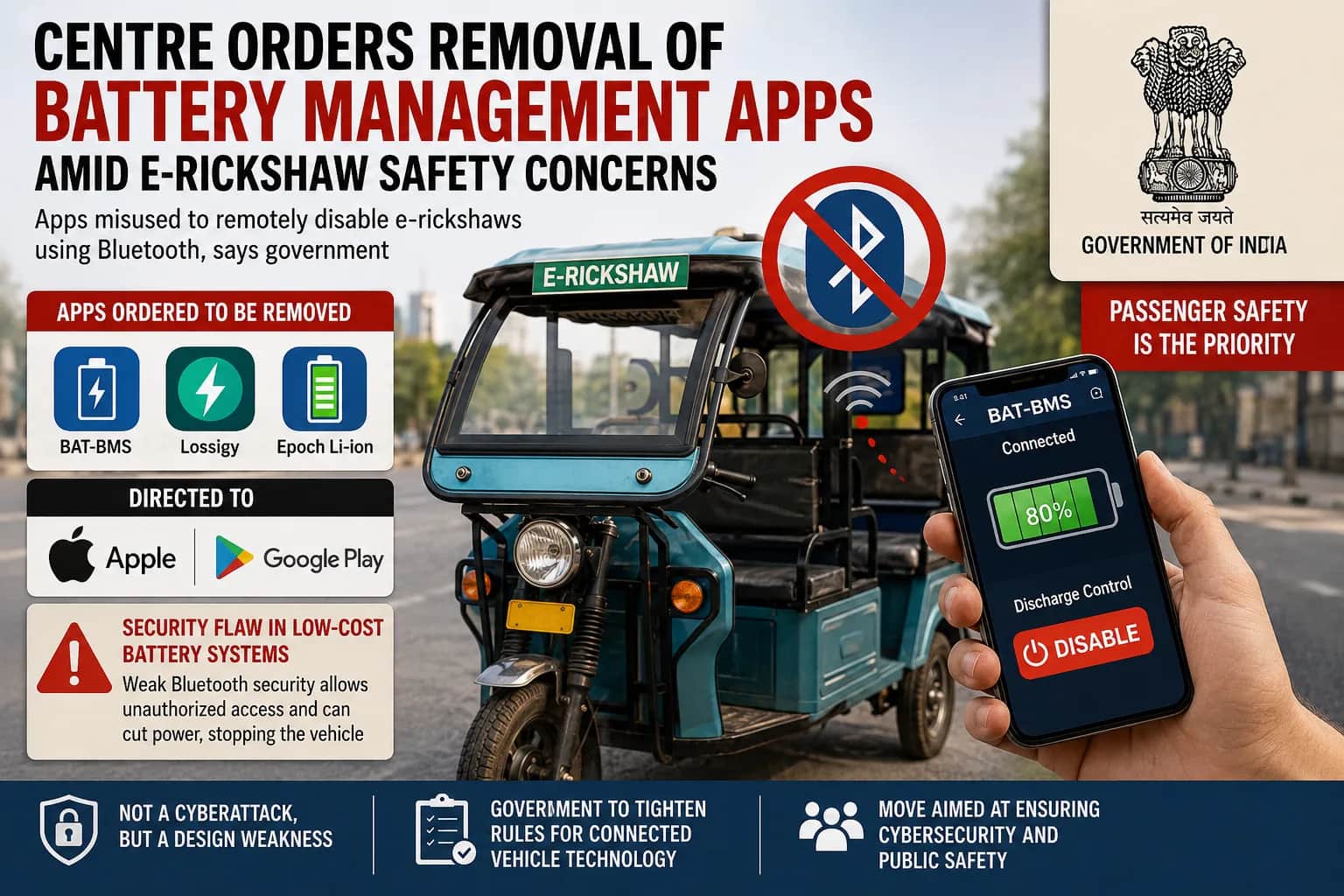
Following worries that they would be abused to remotely disable e-rickshaws, the Central government ordered Apple and Google to remove a number of battery management apps from their respective app stores. The move was made in response to films that appeared on social media that showed people using Bluetooth to connect to adjacent electric rickshaws and turning off their battery systems while the vehicles were moving, raising grave worries about cybersecurity and passenger safety.
Officials think that free public access to such programs poses a possible threat to thousands of electric rickshaws operating across the country.
Apps Identified for Removal
BAT-BMS, Lossigy, and Epoch Li-ion are among the applications that have been flagged for removal, according to government officials. At least two of these apps are purportedly of Chinese origin. IT Secretary S. Krishnan stated that authorities would continue to collaborate with app store operators to prevent similar programs that could jeopardize public safety from becoming widely accessible. He also verified that the Center had directed Apple and Google to remove the applications.
The action is a component of a larger initiative to improve connected mobility solutions' cybersecurity requirements.
What is BAT-BMS?
Initially, BAT-BMS was intended to be a valid battery management program for Bluetooth-capable lithium-ion batteries. It allows users to monitor battery parameters such as charge level, voltage, temperature, charging cycles, and overall battery health.
The app also enables users to specify charging and discharging settings for compatible Battery Management Systems (BMS), making it a helpful diagnostic tool for battery manufacturers, service centres, and maintenance personnel.
Security Flaw Lies in Battery Systems
Government officials have stressed that the issue is not with the applications themselves but with the inadequate security architecture of certain low-cost Battery Management Systems installed in some lithium-powered e-rickshaws.
Many of these battery systems reportedly lack password security or safe authentication. Because of this, anyone who is in Bluetooth range can use suitable apps to couple their smartphone with the battery and turn off its discharge feature. The car stops instantly when the discharge circuit is turned off because the motor's power supply is cut off.
Concerns regarding the safety of drivers and passengers have been raised by this vulnerability, especially in busy urban settings.
Experts Call It a Design Weakness, Not a Cyberattack
Rather than a sophisticated cyberattack, cybersecurity experts have characterized the problem as a product security weakness. They point out that rather than malicious malware built into the apps, the problem results from some battery systems' inadequate Bluetooth security implementation.
While many well-known manufacturers of electric vehicles use proprietary or encrypted Battery Management Systems that cannot be accessed in the same way, it is thought that the issue only affects some inexpensive lithium battery packs.
Government Likely to Tighten Safety Standards
The incident has prompted authorities to consider stricter regulations for Battery Management Systems used in electric vehicles. Industry experts believe future standards may require stronger authentication protocols, encrypted Bluetooth communication, and mandatory cybersecurity testing before such systems are approved for commercial use.
As India's electric mobility sector continues to expand rapidly, the government is expected to place greater emphasis on cybersecurity and product safety to ensure that connected vehicle technologies cannot be exploited in ways that endanger public safety.
"Following worries that they would be abused to remotely disable e-rickshaws, the Central government ordered Apple and Google to remove a num…"