
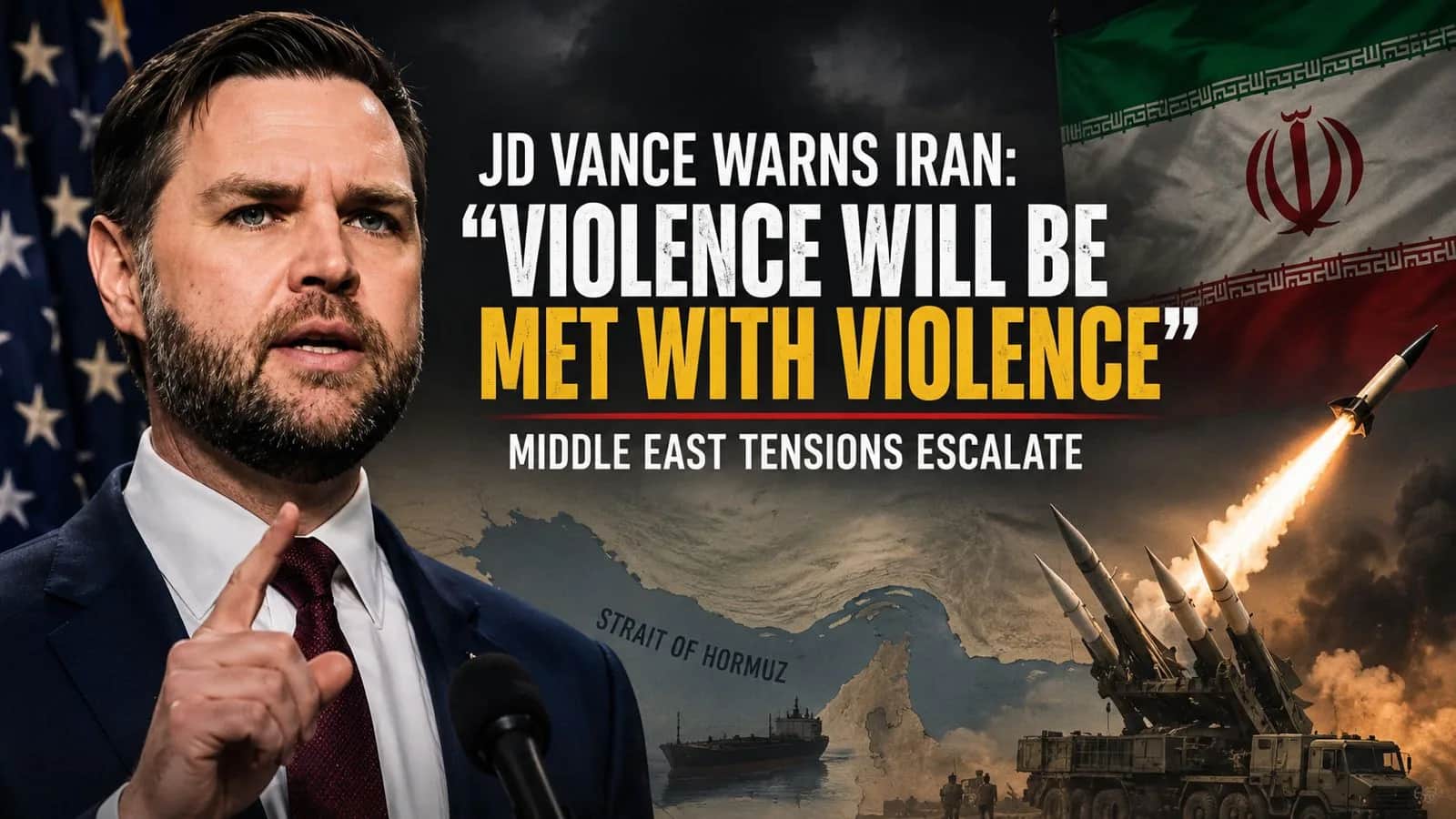
For millions of people across the Middle East, every new missile launch brings back an old fear-not just of war, but of losing their homes, their livelihoods, and their sense of normalcy.
That fear has intensified once again after U.S. Vice President JD Vance issued a blunt warning to Iran, saying, "Violence will be met with violence." His remarks come amid renewed military tensions between Washington and Tehran, raising concerns that a fragile ceasefire could be slipping away.
According to the United States, Iran was behind recent drone and missile attacks targeting commercial shipping near the Strait of Hormuz, one of the world's busiest and most strategically important maritime routes. In response, the U.S. launched strikes on Iranian missile storage sites, drone facilities, and radar systems, calling the operation a necessary response to protect international shipping and deter further attacks.
Reacting to the developments, JD Vance accused Iran of violating the ceasefire understanding reached earlier this month.
"If there's a disagreement, pick up the phone. Violence will be met with violence," Vance wrote, urging Tehran to return to diplomacy instead of military action.
Iran, however, rejected the allegations, insisting that its actions were defensive and warning that it would respond to any further military aggression. The exchange has once again pushed the region closer to uncertainty.
Why the World Is Watching
The latest confrontation is not just about two countries exchanging threats.
The Strait of Hormuz carries nearly 20% of the world's oil supply. Even a brief disruption can drive up global oil prices, increase transportation costs, and ultimately affect ordinary consumers through higher fuel and food prices.
Countries like India, which import a significant portion of their crude oil from the Gulf, could also feel the economic impact if tensions continue to escalate.
Behind the Headlines Are Ordinary Lives
While world leaders exchange warnings, it is ordinary families who often pay the highest price.
Every military escalation forces parents to worry about their children's safety, businesses to suspend operations, flights to be cancelled, and workers to wonder whether they will be able to return home safely. Communities across the region have lived through years of uncertainty, and every new confrontation revives fears of another prolonged conflict.
A Long History of Distrust
The tensions between the United States and Iran are rooted in decades of political and military rivalry.
Relations deteriorated after the 1979 Iranian Revolution and the U.S. Embassy hostage crisis. Since then, disagreements over Iran's nuclear programme, economic sanctions, regional influence, and support for armed groups have repeatedly strained ties.
In 2020, the U.S. killing of Iranian General Qasem Soleimani pushed both nations to the brink of war. Although diplomatic efforts in recent months had shown signs of progress, with discussions on nuclear inspections and regional security, the latest exchange of attacks has cast fresh doubt on those efforts.
What Happens Next?
The United States says it remains open to dialogue but has made it clear that any future attacks on American interests or international shipping will invite a stronger response.
Iran, meanwhile, insists it will defend its sovereignty and refuses to negotiate under military pressure.
For now, the world is watching closely, not just because of the political standoff between Washington and Tehran, but because history has shown that conflicts in the Middle East rarely remain confined to one region. Their impact is often felt in global markets, international diplomacy, and, most importantly, in the lives of millions of ordinary people hoping for peace.
"For millions of people across the Middle East, every new missile launch brings back an old fear-not just of war, but of losing their homes, …"