Nine days after the deadly flash floods that struck the region near China's Tibet border, rescuers in Nepal are intensifying their efforts to locate hundreds of workers who are thought to be trapped in tunnels.
After two people were rescued alive on Friday, hopes have increased. In one of the tunnels that serves a hydropower plant, the body of a third person was discovered.
Rescue efforts intensify as hopes rise
In Nepal and Tibet, there are atleast 1,311 confirmed dead and 5,330 unaccounted for. At least 34 countries are thought to have hundreds of missing foreign nationals.
It is uncertain how the flood will affect Tibet in its entirety. China has published information about the destruction along the border through official media channels, but it hasn't provided much information about the victims or the effects on nearby communities.
However, rescue efforts are underway in Nepal in seven hydropower tunnels where over 150 people are reportedly trapped, as well as in 19 other locations.
Two workers rescued from Trishuli 3A tunnel
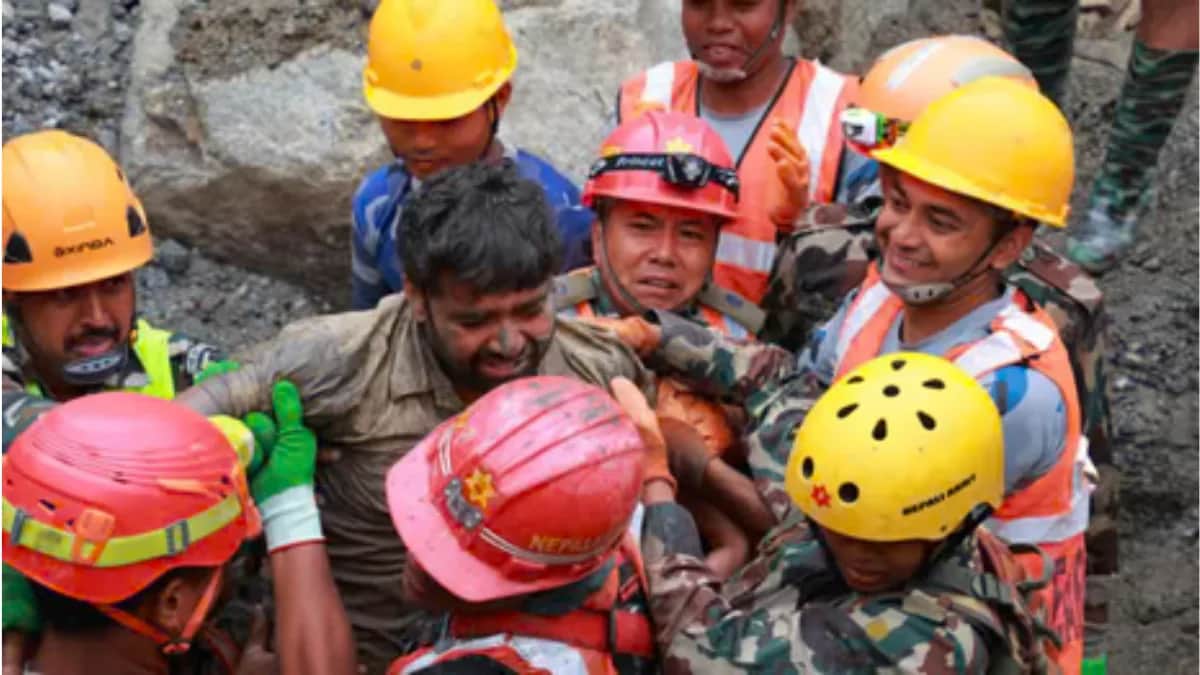
Rescuers at the Trishuli 3A hydropower site heard what they believed to be voices early on Friday morning.
They said, "Don't worry, we're here to rescue you," and heard a weak "Okay" in response, according to local sources.
Sanjay Shah and Kabir Maharjan suffered bruises on their hands and legs, "possibly" from crawling through the tunnel, when rescuers crawled in to find them. Both were transported by plane to the Army Hospital in Kathmandu, the nation's capital.
According to the prime minister's office, Maharjan, who was saved second, is in critical condition. Shah was also being medically examined.
Later, the body of a third person was discovered in the same tunnel. According to a local officer, it was bloated and difficult to identify immediately.
Although it is unclear if all 39 individuals are still alive, officials believe they are in the Trishuli 3A tunnel.
Rescuers face challenges as tunnels remain blocked
Following the sudden floods on August 26, Col. Jhabindra Reshmi reported that his teams had saved 270 foreigners and over 400 Nepali nationals.
According to him, rescuers had to drill access holes in order to enter the tunnels because of the mud and rocks.
According to a representative for Nepalese electricity providers, a lot of heavy machinery was washed away by last week's flooding, making it more difficult for rescuers to unblock the tunnels.
The two men's rescue on Friday will "motivate the rescuers to do more," according to Uttam Bhlon Lama, vice president of Independent Power Producers of Nepal, who spoke to the BBC's Newsday programme.
"The flood level is still very high," Lama continued.
Rainfall could result in more flooding in the area, according to Nepalese authorities.
There are at least 1,287 confirmed deaths and 5,083 unaccounted-for individuals in Nepal.
Chinese media stated on Friday that 31 Tibetans had died and 531 were still missing.
Instead of holding out hope for more survivors, emergency teams in Tibet seem to be concentrating on aiding those who survived.
Glacial collapse suspected as cause of deadly floods
Although the precise cause is still being investigated, a glacier collapse is thought to have been the cause, and climate change may have played a role.
Shortly after the seismic event, which was initially believed to be an earthquake, a huge wall of water and debris rushed downstream, carrying cars, buildings, and roadways with it.
Better early-warning systems may have prevented fatalities, according to experts from China's Institute of Mountain Hazards and Environment, the Stimson Center, and the Asian Mountain Academic Alliance. There was evidence of increasing instability surrounding the glacier in the days preceding its collapse.
"Nine days after the deadly flash floods that struck the region near China's Tibet border, rescuers in Nepal are intensifying their efforts t…"