
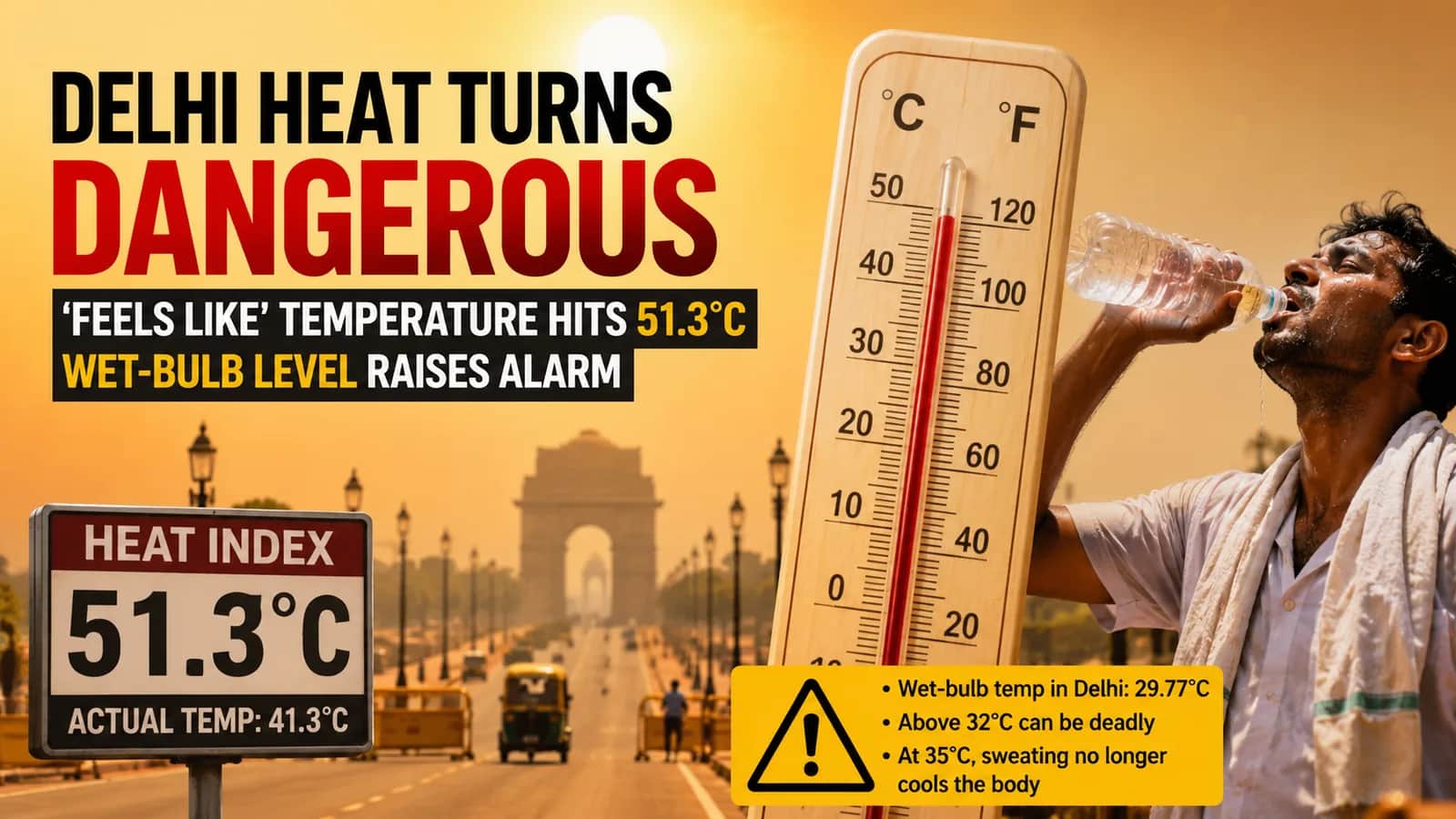
The soaring temperature of Delhi has sparked a very serious concern because the city’s heat index, or “feels like” (apparent) temperature reached 51.3 degrees Celsius on Saturday, according to the India Meteorological Department.
This is the year’s highest recorded heat index. But the real thermometer is showing 41.3 degrees Celsius. However, both numbers are real and tell different stories.
Air temperature and Heat Index
The air temperature is 41.3 degrees Celsius, which is around 4 degrees higher than the usual temperature. The heat index, which is recorded at 51.3 degrees Celsius, is how the body feels when humidity is taken into account. Humidity refers to water vapour in the air. The more humidity there is, the harder it is to keep the body cool.
The IMD says that after Monday, the temperature is expected to fall, and rain and strong winds are also expected. A yellow alert has been issued for Tuesday and Wednesday.
The wet-bulb temperature of Delhi has reached 29.77 degrees Celsius. It may sound low, but it is not because even a fit and healthy human cannot survive above 32 degrees wet-bulb temperature. At around 35 degrees Celsius of wet-bulb temperature, sweating no longer cools the body effectively and Delhi is gradually moving closer to this serious issue.
What is Wet-Bulb temperature?
The lowest temperature that can be reached by evaporating water into the air is known as the Wet-Bulb temperature. It shows how well our bodies can cool down through perspiration by combining measurements of heat and humidity.
How does it work?
A moist, water-soaked cloth is wrapped around the bulb of a standard thermometer to determine the wet-bulb temperature. Water evaporates from the cloth when air moves over it, absorbing heat energy and lowering the thermometer’s temperature. The temperature reading will drop sharply if the surrounding air is dry because evaporation occurs quickly.
However, if the air is already saturated with moisture (high humidity), evaporation slows down or stops, so the wet-bulb temperature stays near or equal to the actual air temperature.
Skymet Weather's Vice President of Meteorology and Climate Change Mahesh Palawat said, winds from the Arabian Sea are bringing moisture to northwest India. The monsoon, which typically brings cool rain from the Bay of Bengal, is still far away. Delhi’s summer is usually dry, but this time it is a wet summer, and wet summers are more dangerous to life.
"The soaring temperature of Delhi has sparked a very serious concern because the city’s heat index, or “feels like” (apparent) temperature r…"