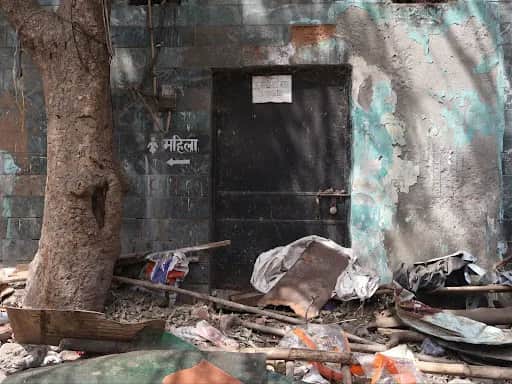
Saumya, a 12-year-old girl, wakes up every morning with a dream. “I want to go to school, and I want a toilet for our family that is free and open all the time,” she says. In Sonia Gandhi Camp and Nehru Ekta Camp in RK Puram Sector 6, children like Saumya have to travel across neighbourhoods just to use the toilet. In these two slum clusters, there are more than 1500 households combined, but only five to six toilets and bathrooms. “They charge us money for using the toilets, and at night we have to defecate near garbage dumps, sometimes behind the cars,” her mother said.
The ODF Fallacy of Delhi
Delhi was declared not just ODF (Open Defecation Free) but ODF++, under the Swachh Bharat Mission, meaning all community and public toilets are functional and well-maintained, and sewage is treated safely. Despite being declared ODF++ in several areas, such as these camps, they face issues of maintenance, hygiene, and even sewage treatment.
Open Defecation Hits Women and Children the Hardest
These camps are located near the posh localities of South Delhi. But behind this proximity lies a reality of ignorance, where access to even basic sanitation facilities remains a daily challenge. Several people, including children and women, face the problem of open defecation in these areas. Most women there bear the brunt of these non-functional facilities as they have to defecate openly.
“Men can easily go out to urinate, but people see us defecating in public, we feel embarrassed.”
A woman said who lives near a female public toilet that was closed years ago.
“It has been under repair for 3 years,” her 19-year-old son adds. A dholak player earning five to ten thousand rupees a month, he left school at 14 to support his family. They live in a makeshift tarpaulin shelter by the roadside near Sonia Gandhi Camp.
Residents Forced to Pay for Basic Sanitation
People reported that contractors of these public toilets charge maintenance fees and sometimes charge 20, 30, or even 50 rupees for defecating, bathing, and washing. This activity of charging, although illegal, continues because people don't have alternative options; either they give money or defecate behind cars, near garbage dumps, or wait till they arrange money to use the toilet. “It’s none of your business, do your work,” a contractor of DUSIB (Delhi Urban Shelter Improvement Board) community toilet said when asked why he was taking money for a free-to-use toilet. Most toilets in these areas are not well-maintained, and those that are maintained charge illegally from the citizens.
Kusumpur Pahadi’s Persistent Sanitation Crisis
Just three kilometres away from Sonia Gandhi and Nehru Ekta Camp, Kusumpur Pahadi exists. The area is known for never receiving piped water. Here, the toilets lack a proper water supply, taps are broken, and the area is marked by a persistent stench of human excreta, indicating the neglect of basic sanitation facilities. The area is located on a hillock with over 4900 households, but the area continues to face inadequate sanitation infrastructure. “These toilets are rarely cleaned, and sometimes we have to clean these toilets ourselves just to be able to use them,” a woman resident of Pahari said.
Broken and non-functional toilets of Kusumpur Pahadi
Health Risks of Open Defecation
Dr Nancy, a medical expert at Kalawati Saran Hospital, said,
“Open defecation can lead to serious health problems in children, and it can lead to fever, diarrhoea and other diseases, which can lead to improper growth in children.”
Women can face urine infection, bladder infection and kidney infection during defecating openly, she further added.
A community toilet by DUSIB in Nehru Ekta Camp
When Statistics Clash With Ground Reality
According to the Delhi Urban Shelter Improvement Board, all JJ clusters (Jhuggi Jhopri clusters) in Delhi were declared ODF in 2018, but our ground report suggests otherwise. As of December 2025, Delhi has utilised 38% of the funds allocated under SBM 2.0 (Swachh Bharat Mission), which is higher than the national average. However, this still leaves 62% of the central funds allocated to Delhi for the period 2021–2026 untapped, with less than a year remaining in the mission period.
"Saumya, a 12-year-old girl, wakes up every morning with a dream. “I want to go to school, and I want a toilet for our family that is free an…"