
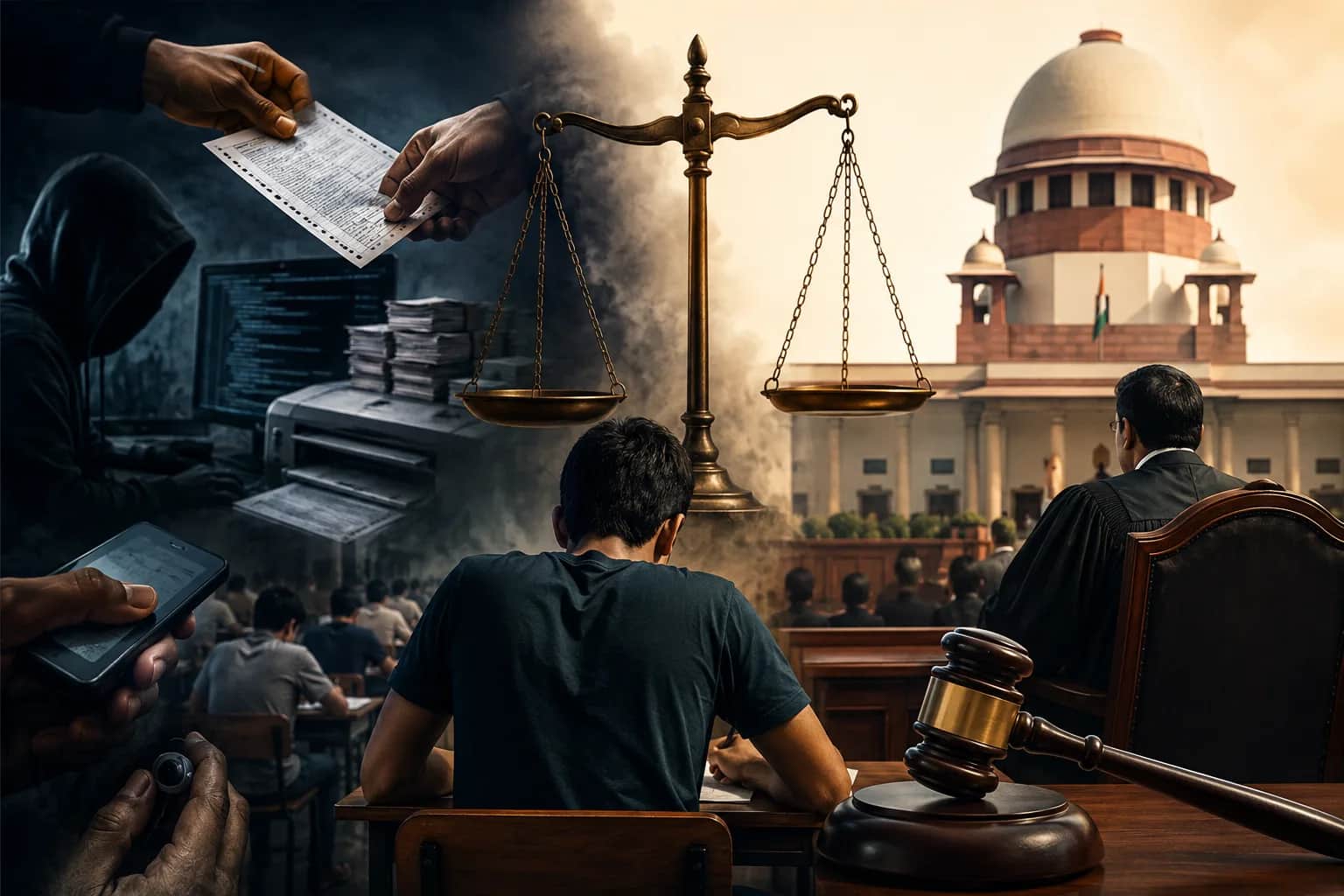
With the increasing outrage all across the country regarding the persistent problem of paper leak cases in examinations, the Prime Minister of India, Mr. Narendra Modi declared that the government would set up fast track courts which would ensure that such persons who have indulged themselves in paper leak cases are punished strictly.
Speaking about the youth of India, the Prime Minister of India emphasized that the future of India lies in the hands of its youth and it was their highest priority for the government and hence nobody will be left unpunished for putting them in jeopardy. Such declaration was made amidst continuous student demonstrations and increased demand for accountability in India's examination process.
This statement has received wide acceptance although it has sparked off a discussion on whether fast-track courts alone can resolve India's paper leak problem?
What are Fast Track Courts?
To clarify, fast-track courts are not an additional set of constitutional courts; there is no unified law governing such courts in India either. Fast-track courts are specialized courts, established within the existing legal system, which can handle certain kinds of cases expeditiously.
India has seen this practice before as well. In accordance with the recommendations of the 14th Finance Commission, fast-track courts have been encouraged in order to expedite pending criminal cases. In 2019, the Center of India set up Fast Track Special Courts (FTSCs) with partial funding from the Nirbhaya Fund that would hear cases related to rape and POCSO on priority.
A Solution through Law with Constitutional Restrictions
However, even with the announcement, it is not possible to form fast-track courts overnight.
According to legal scholars, the creation of special courts will have to meet constitutional requirement laid out in Article 14 of the Constitution, which provides for equality before the law. As per the judgment of the case of State of West Bengal vs. Anwar Ali Sarkar (1952), "Speedier trial by itself could not be a reasonable classification."
In other words, the proposed solution will necessitate coordination between the central government and the concerned states and their High Courts.
The Bigger Issue: Substandard Investigations, Not Slow Courts
Whereas fast track courts might expedite proceedings, they cannot resolve the issue of substandard investigations.
According to an investigation conducted by The Indian Express newspaper, there have been as many as 45 instances of examination paper leaks since 2002 until 2025, wherein one lakh or more candidates have been affected. However, only two of these cases have led to conviction.
The reasons pointed out by the investigation include substandard quality of investigations, inadequate collection of evidence, lack of prosecution, and lenient legal handling of the crime of paper leak.
Cases Demonstrating Systemic Inefficiencies
Some notable cases highlight the reasons for infrequent convictions.
Regarding the leak of the Karnataka PUC Chemistry exam paper in 2016, the Bengaluru Sessions Court dismissed the charges against 19 accused people, including some senior officers and the mastermind of the scam on account of serious flaws in the investigation.
Similarly, a magistrate also dismissed the closure report filed by the police regarding an examination held for the UP Public Services Commission Review Officer.
In a similar vein, in the UGC-NET 2024 paper leak case, the Delhi court criticized the CBI for filing a closure report despite substantial evidence that a leak had taken place.
Paper Leak Syndicates Have Gained Sophistication
The nature of exam cheating has also changed significantly.
Whereas it used to entail photocopies and faxes, it now entails criminal syndicates utilizing Bluetooth gadgets, encryption technology, remote access technology, among others.
There have been instances that have been documented by law enforcement agencies, including those of the 2023 Bihar Police Constable Exam, in which examination papers were alleged to have been stolen from the printer to an unauthorized warehouse, and the 2024 UP Police Constable Exam, in which trunks containing sealed exam questions were allegedly interfered with without removing the seals.
Fast Track Courts Are Just Part of the Solution
India has its Public Examination (Prevention of Unfair Means) Act, 2024. The act has severe punishments for any group trying to leak papers. However, the government wants to make things stronger by adding faster trials and increased jail terms.
The problem is that legal authorities claim that if the investigations aren't strengthened, if the examination process isn't made safer, then there won't be many convictions even with the fastest courts.
The Road Ahead
Modi's statement is the most robust response made by the government to the Indian papers leak scandal. It recognizes that lack of timely justice has led to loss of faith in the testing procedure among the populace. However, past experience shows that time alone cannot ensure justice.
While fast track courts will help speed up the judicial process, only a huge effort such as that involving thorough investigation, institutional protection, modernized exam procedures, and accountability will be able to restore the students' confidence.
It will thus be possible for India to ensure that its competitive examinations test merit rather than organized crime.
In case you want, I can also develop this article into a magazine-type investigative piece.
"With the increasing outrage all across the country regarding the persistent problem of paper leak cases in examinations, the Prime Minister …"