
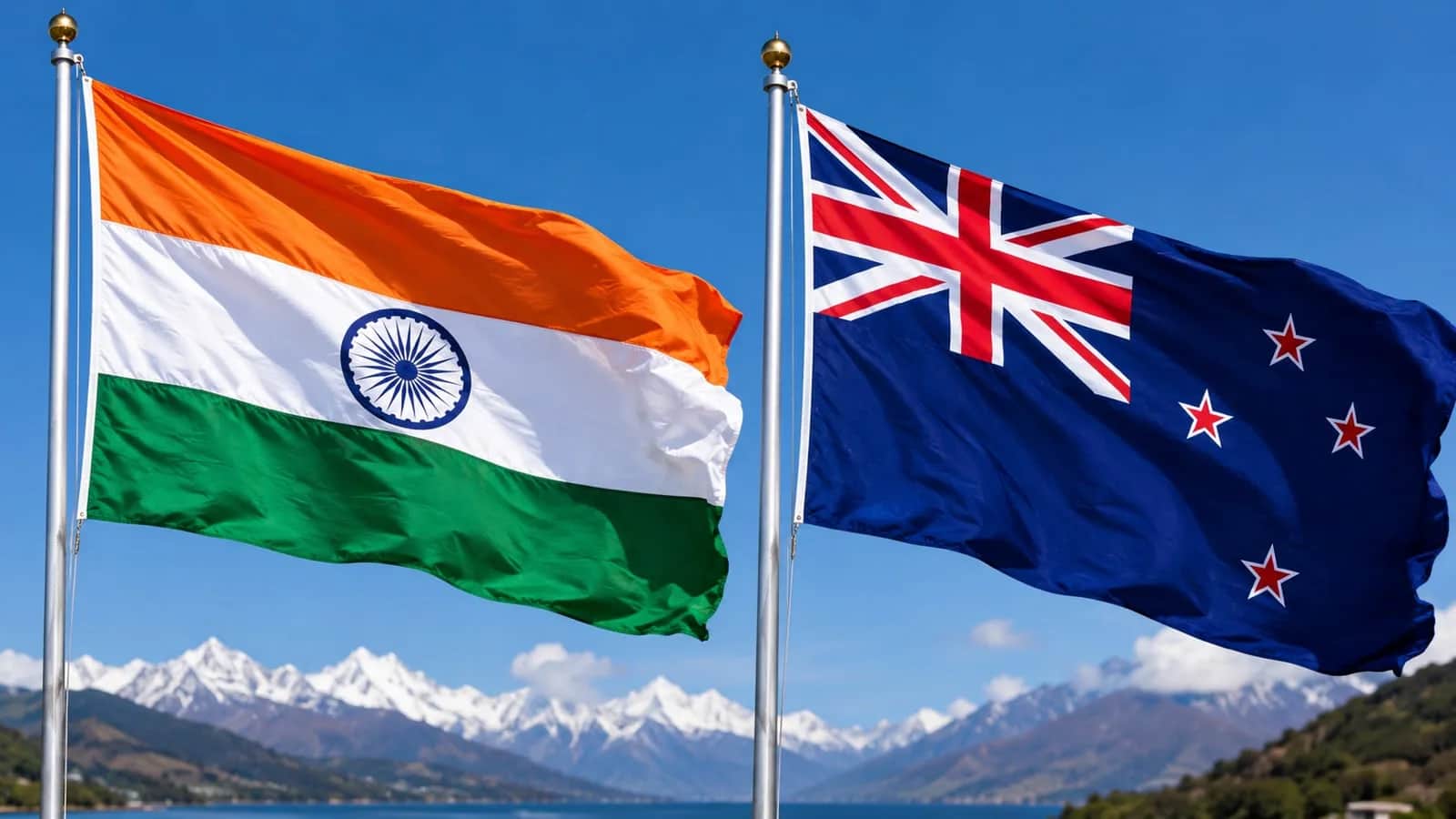
In the first bilateral visit by an Indian prime minister to the island nation in almost forty years, Prime Minister Narendra Modi met with his New Zealand counterpart, Christopher Luxon, on Saturday, elevating their bilateral relationship to a Strategic Partnership and marking a significant milestone in ties. In addition to reiterating their shared commitment to a free, open, and rules-based Indo-Pacific, the leaders promised to strengthen cooperation in defense, trade, maritime security, technology, education, and innovation.
While addressing the bilateral meeting in Auckland, Modi describes India and New Zealand as two maritime democracies whose growing partnership would strengthen peace and stability in the Indo-Pacific.
"As two maritime nations, our close cooperation lends new strength to the Indo-Pacific, and our ties can infuse fresh energy into achieving our shared goals of peace," he said.
The visit marks the final leg of Modi's three-nation tour, following engagements in Indonesia and Australia, where regional security and Indo-Pacific cooperation also dominated discussions.
A Historic Visit After 40 Years
Modi was on a two-day official visit to Auckland (July 10-11), the first Indian prime minister to pay a bilateral visit to New Zealand since the 1986 visit of Rajiv Gandhi. The nearly 40 year gap reflects the fact that despite cordial ties the relationship remained relatively low key at the highest political level for decades.
While no Indian Prime Minister visited New Zealand after Rajiv Gandhi, engagement between the two countries continued through regular ministerial exchanges and visits by New Zealand leaders. Former New Zealand Prime Minister John Key visited India in 2011 and 2016, while Prime Minister Christopher Luxon travelled to India in 2025, where both countries revived negotiations on a Free Trade Agreement (FTA) and agreed to deepen cooperation in defence, trade and education. Earlier this year, India and New Zealand concluded the FTA, providing fresh momentum to bilateral economic relations.
From Diplomatic Friendship to Strategic Partnership
India and New Zealand established diplomatic ties in 1952. Both vibrant democracies, members of the Commonwealth and supporters of a rules-based international order. Bilateral engagement, however, was limited for much of the Cold War, with India’s foreign policy focused on South Asia, the Soviet Union and economic development, while New Zealand’s strategic priorities were centred on Australia, the United Kingdom and the United States.
The relationship began expanding after India's economic liberalisation in 1991, with growing cooperation in trade, education, agriculture and people-to-people exchanges. In recent years, the emergence of the Indo-Pacific as the world's most strategically significant region has added a new dimension to bilateral ties, bringing the two countries closer on regional security and maritime cooperation.
Why India cares about New Zealand
With a population of just over five million, New Zealand occupies an important position in the South Pacific and has emerged as a key partner in India’s Indo-Pacific strategy. Both countries support freedom of navigation, secure sea lanes and respect for international law.
New Zealand is another important destination for Indian students. The Indian-origin community, which was around 292,000 in New Zealand’s 2023 Census, has emerged as one of the fastest growing communities in the country and is a pillar of people-to-people ties. The two countries are also enhancing cooperation in agriculture, food processing, digital innovation and clean energy.
Key Takeaways from Modi’s Visit
The visit’s highlight was the decision to elevate bilateral ties to a Strategic Partnership and launch a Roadmap to 2030 aimed at boosting cooperation in defence, trade, investment, science, technology, education, agriculture and innovation.
The two leaders also signed a Defence Cooperation Arrangement to boost cooperation on maritime security and regional stability. The visit led to the signing of 18 agreements and cooperation documents in sectors like defence, trade, security, education and technology, demonstrating the growing convergence between the two democracies.
Centre for Indo-Pacific
The visit also reflects India’s broader strategic outreach across the Indo-Pacific at a time of growing geopolitical competition in the region, beyond the scope of bilateral cooperation. Without naming China, both leaders stressed the importance of a free, open and inclusive Indo-Pacific, safe sea lanes and a rules-based international order.
This visit marks a milestone in India’s evolving relationship with New Zealand from a traditionally friendly relationship to a comprehensive strategic partnership. Modi’s visit is seen as a defining moment that could set the tone for India-New Zealand relations for the next decade, with New Delhi looking to build stronger ties with trusted democratic partners across the Indo-Pacific.
"In the first bilateral visit by an Indian prime minister to the island nation in almost forty years, Prime Minister Narendra Modi met with h…"