
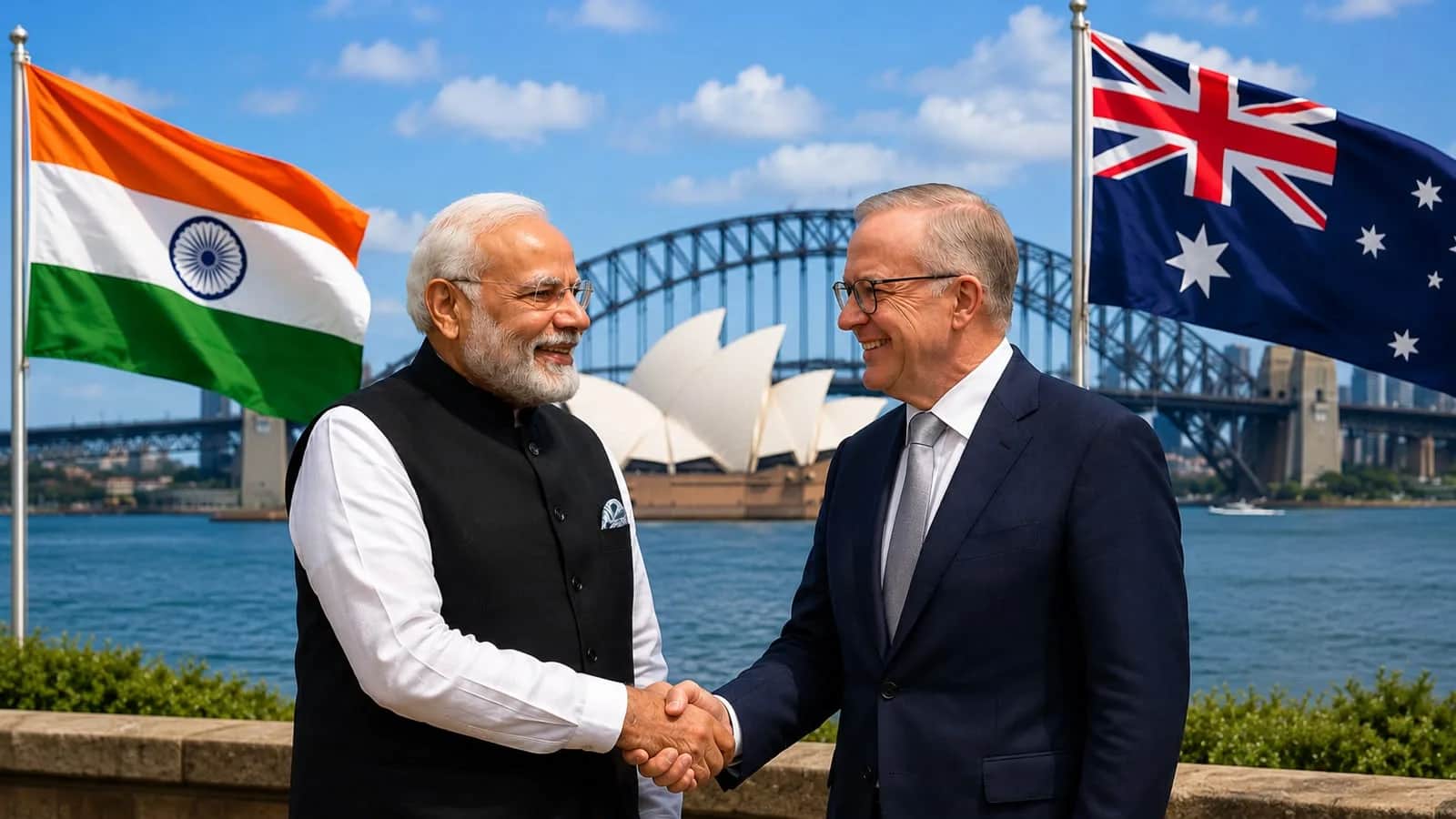
A new chapter in India-Australia relations has begun with Prime Minister Narendra Modi's three-day visit to Australia. The two nations unveiled eighteen major outcomes that greatly strengthen collaboration in defence, civil nuclear energy, critical minerals, cyber security, education, and trade. PM Modi and his Australian counterpart Anthony Albanese decided to expedite talks on the Comprehensive Economic Cooperation Agreement (CECA), oThe two countries operationalised their long-standing civil nuclear cooperation framework by finalising arrangements that will enable Australia to supply uranium to India for peaceful civilian nuclear use under international safeguards.. When taken as a whole, the agreements show how the two Indo-Pacific democracies are increasingly strategically convergent.
Defense and Indo-Pacific Security Take Center Stage
The visit's greatest highlight was security cooperation. The 2009 framework was replaced by an enhanced roadmap centered on military interoperability, defense industry collaboration, cyber security, counterterrorism, marine domain awareness, and humanitarian assistance when both leaders updated the Joint Declaration on Defence and Security Cooperation.
In order to improve information exchange and operational coordination at sea, the nations have introduced a Maritime Security Collaboration Roadmap. The rising strategic trust between the two countries is further demonstrated by an agreement between the Indian Coast Guard and Australia's Maritime Border Command, as well as Australia's decision to host an Indian military instructer at the Australian Defence College in 2028–2029. Concerned about growing geopolitical tensions and disruptions to global energy supply chains, Modi and Albanese also reaffirmed their commitment to upholding a free, open, and rules-based Indo-Pacific.
Critical Minerals and Uranium Supply Boost Energy Collaboration
The operationalization of the 2014 India-Australia Civil Nuclear Agreement, which permits Australia to export uranium for India's civilian nuclear program under international safeguards, was one of the biggest announcements. In a Joint Statement on Energy Security, the leaders reaffirmed their commitment to working together on critical minerals, clean energy, LNG, and renewable energy.
Modi declared that both nations would collaborate to create a robust critical minerals corridor, citing key minerals as crucial to the clean energy revolution. In order to train about 2,000 women and young people in solar technology, the summit also operationalized Gujarat's Rooftop Solar Training Academy.
Investment, Trade, and Technology Gain New Impetus
Another important pillar of the summit was economic cooperation. Modi and Albanese decided to promote more bilateral investment while expediting the long-pending CECA negotiations. Modi urged Australian companies to invest in India during his speech at the India-Australia CEO Forum, citing the nation's "unmatched opportunities" in industries including aviation, financial services, technology, food processing, and vital minerals.
The goal of PACTS's launch is to strengthen cooperation in the areas of secure supply chains, digital resilience, and cyber security. Further agreements on mining, technology innovation, and geoscience cooperation show both nations' desire to establish strong economic ties. Growing investor confidence was also shown by AustralianSuper, Australia's biggest pension fund, announcing a significant investment of A$500 million, commitment in India's infrastructure sector. Using a cricket analogy, PM Modi said the relationship had gained the pace and momentum associated with a T20 match, reflecting the speed of recent decisions and initiatives.
Diaspora, Culture, and Diaspora strengthen People-to-People ties
Additionally, the summit increased collaboration in research and education. Both nations decided to create a Centre of Excellence in Mining Technology in Bhubaneswar, and Australia approved campuses for Victoria University in Gurugram and Flinders University in Bengaluru. Academic and research cooperation will be enhanced by new collaborations between the Satyajit Ray Film and Television Institute and Griffith Film School, as well as between CSIR and the University of Melbourne.
Three ancient Indian artefacts, a Nandi idol, a Bhadrakali trident, and a Kartikeya sculpture were symbolically returned by Australia, highlighting the strengthening of cultural connections. Speaking to thousands of Indian diaspora members in Melbourne during his third trip to Australia in twelve years, Modi said that the vision of Viksit Bharat would be propelled by the combined efforts of 140 crore Indians and referred to overseas Indians as the "sugar in milk" that enriches their adopted societies. Modi was referred to by Albanese as a "living bridge" between Australia and India.
Beyond Bilateral Agreements: An Exploration of Digital Safety
Modi hailed Australia's historic law prohibiting children under 16 from using social media, stating that India was "learning" from Australia's experience in safeguarding young users on the internet, in addition to defense and trade. His comments have raised questions about whether India could take a similar stance. The government hasn't, however, made any plans to impose a social media ban on minors akin to that of Australia. As of right now, the remarks don't represent a planned legislative action but merely policy interest.
With agreements covering defense, uranium supply, vital minerals, education, technology, and cultural cooperation, the visit has solidified Australia's position as one of India's most significant Indo-Pacific strategic partners and established the groundwork for a more robust, forward-thinking engagement.
"A new chapter in India-Australia relations has begun with Prime Minister Narendra Modi's three-day visit to Australia. The two nations unvei…"