
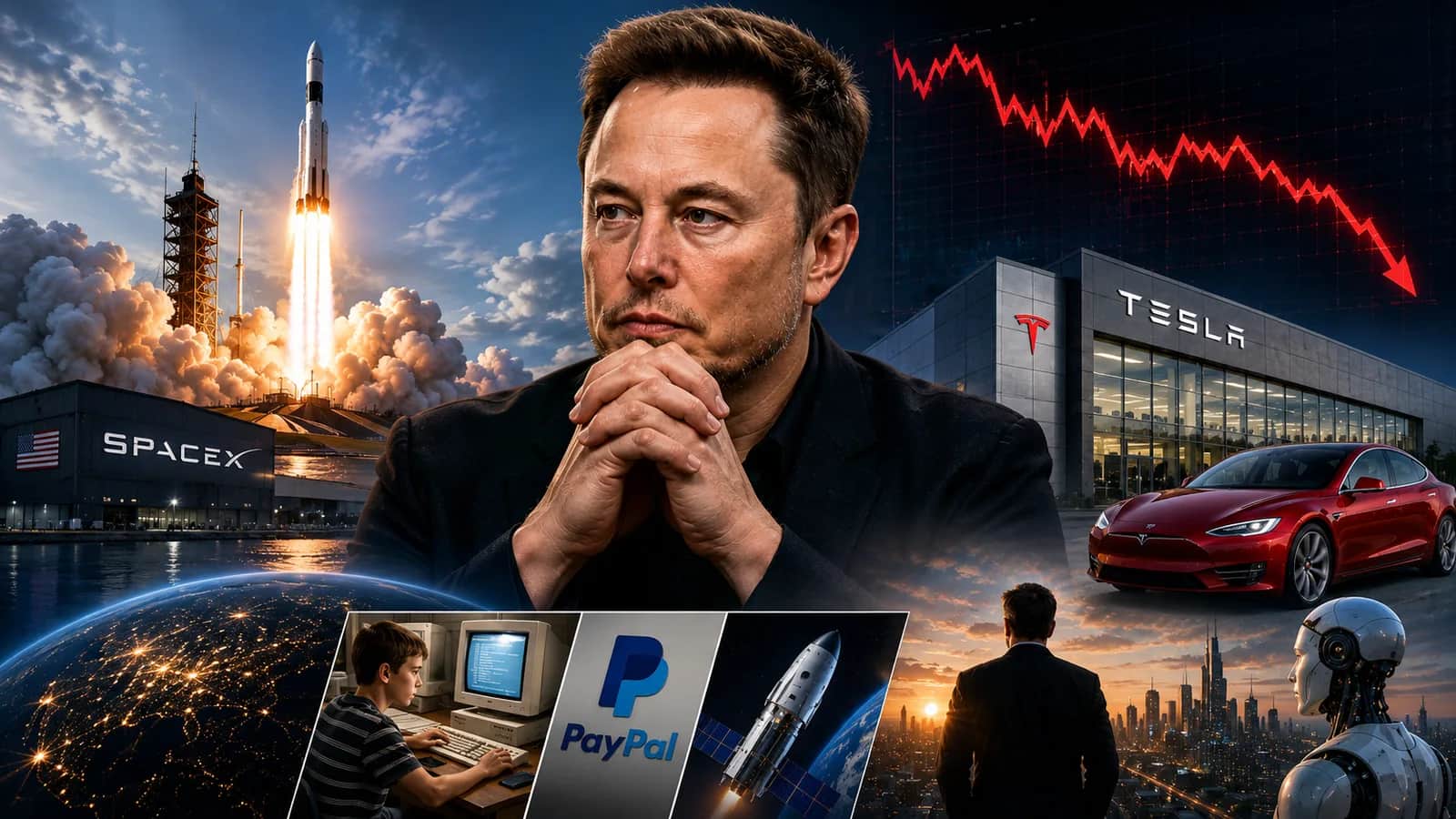
Not long ago, Elon Musk made headlines around the world after becoming the first person in history to cross the $1 trillion net worth mark. It was a milestone many believed was still years away.
But just weeks later, that record has slipped out of his hands.
According to the Bloomberg Billionaires Index, Musk's estimated fortune has fallen to around $956 billion after a sharp decline in the share prices of SpaceX and Tesla. While he remains the world's richest person, the sudden drop shows just how quickly fortunes can change when they are closely tied to the stock market.
A journey that began with a computer game
Long before he became one of the world's most influential entrepreneurs, Elon Musk was simply a curious child growing up in Pretoria, South Africa.
At the age of 12, he taught himself computer programming and created a simple video game called Blastar. He sold it to a computer magazine for about $500- a small amount compared to today's standards, but it was his first taste of turning an idea into money.
In the early 1990s, Musk moved to Canada and later to the United States to pursue higher education. While studying, he became fascinated with technology, clean energy and space exploration industries that would later define his career.
Taking risks that changed everything
Musk's first major business venture was Zip2, a software company that helped newspapers create online city guides. In 1999, computer giant Compaq bought the company for more than $300 million, giving Musk his first significant fortune.
Instead of playing it safe, he reinvested much of that money into another startup, X.com, an online payments company that eventually evolved into PayPal. When eBay acquired PayPal in 2002, Musk earned around $180 million.
For many people, that would have been enough to retire comfortably. Musk chose a different path.
He poured nearly all of his earnings into businesses that many experts at the time considered far too risky.
One was SpaceX, a private space company with the ambitious goal of making human life possible on other planets. The other was Tesla, then a little-known electric vehicle company trying to compete with some of the world's biggest automobile manufacturers.
Both companies struggled in their early years. There were moments when they came close to running out of money. But over time, Tesla revolutionised the electric vehicle industry, while SpaceX became the first private company to regularly send astronauts and cargo into space.
Those successes transformed Musk from a millionaire into the richest person on the planet.
How did he become the world's first trillionaire?
The answer lies in the soaring value of the companies he owns.
Unlike celebrities or athletes whose wealth often comes from salaries, Musk's fortune is almost entirely linked to his ownership stakes in Tesla and SpaceX.
Earlier this month, SpaceX made its much-awaited stock market debut. Investors rushed to buy shares, betting on the company's future in commercial space travel and satellite technology.
The stock was listed at around $135 per share, but enthusiasm pushed it to nearly $225 within a short period.
Tesla's shares were also trading at strong levels.
Together, the rising valuations of both companies pushed Musk's estimated net worth above $1 trillion, making him the first individual ever to achieve that milestone.
It was a historic moment not because Musk suddenly earned trillions of dollars in cash, but because the market value of the companies he owns reached extraordinary levels.
So, what changed?
Financial markets are known for their ups and downs, and billionaire fortunes often move with them.
After the initial excitement around SpaceX's listing, investors began booking profits. At the same time, technology stocks witnessed a broader sell-off as markets became cautious about high valuations.
Within days, SpaceX's share price dropped by nearly 16%, falling to around $156. Tesla's shares also declined during the same period.
Because Musk owns large portions of both companies, the fall in their share prices translated into a massive decline in his estimated wealth.
In simple terms, the value of the assets he owns became lower on paper, pushing his fortune below the trillion-dollar mark.
Did Elon Musk actually lose billions?
Not in the way most people imagine.
Musk didn't withdraw billions from a bank account, nor did he spend or transfer the money.
His wealth is mostly “paper wealth”, the estimated value of the shares he owns. When stock prices rise, his net worth increases. When they fall, it decreases.
If Tesla and SpaceX shares recover in the coming weeks or months, Musk could once again reclaim the trillionaire title.
A reminder about modern wealth
Elon Musk's story is more than just a tale of numbers. It reflects how modern fortunes are increasingly shaped by investor confidence and market sentiment.
Even after this decline, Musk remains the richest person in the world, with businesses that continue to lead innovations in electric vehicles, reusable rockets, satellite internet and artificial intelligence.
His brief rise above the trillion-dollar mark and the equally swift fall below it shows that in today's financial markets, even record-breaking wealth can change almost overnight.
"Not long ago, Elon Musk made headlines around the world after becoming the first person in history to cross the $1 trillion net worth mark. …"