
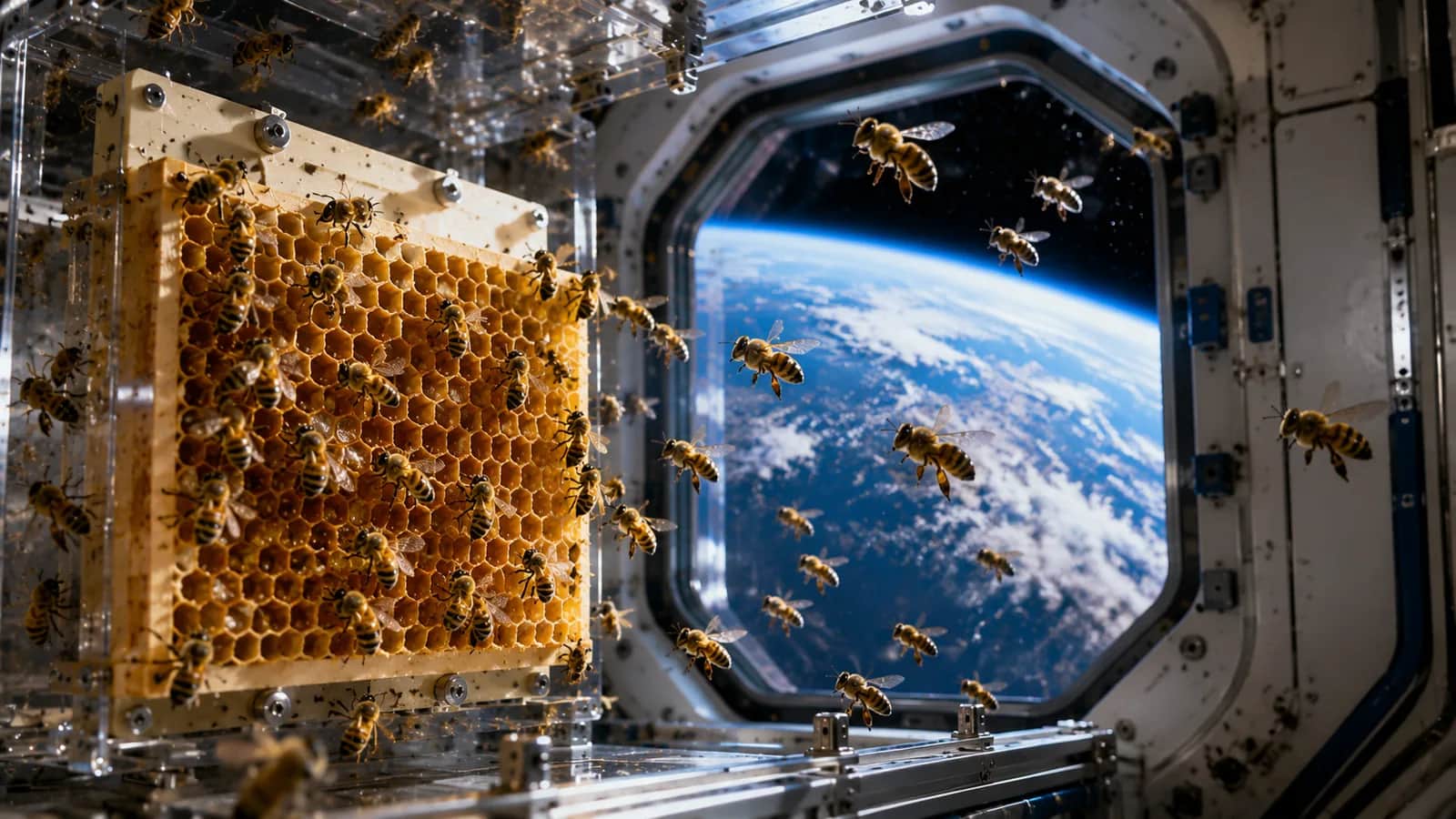
Space is synonymous with terms such as astronauts, rockets, and future colonies. However, what would happen if an extremely well-organized insect was taken to space? Are honeybees able to survive in microgravity and even create a hive without the effects of earth's gravity?
This intriguing question was answered by scientists from NASA who experimented with honeybees.
NASA Has Sent Thousands of Bees To The Space
One of the most interesting experiments was carried out in 1984 by NASA using the Space Shuttle Challenger mission, STS-41-C where 3,300 honeybees were taken to space. They wanted to see how the bees would react in microgravity and whether they can retain their instincts to build hives.
At first, the bees seemed confused. Without any gravity, they found it hard to control their movements and orientation in flight mode. Their behavior looked strange in the new environment.
Bees Ultimately Formed a Hive
Over several days, however, the bees got used to the microgravity and performed their regular tasks again. The most amazing thing about the experiment is that the bees began building a hive.
The bees managed to build an object which was almost 31 square inches in size. Moreover, the object had the same well-known hexagonal design typical of honeybee hives on Earth.
Thus, according to the experiment, gravity is not the only thing affecting the building of hives by honeybees. Their behaviour is affected by many other biological factors.
The Queen Bee Laid Eggs As Well
Another exciting result of the experiment is that the queen bee laid 35 eggs during the mission. Thus, it became clear that the reproduction process could occur even in such special conditions.
Nevertheless, the experiment is quite small-scale, and cannot prove that honeybees could build their own colony in space.
Bees for Space Farming in the Future?
Bees have been playing an important role on Earth because of their ability to pollinate many different flowers and agricultural crops. In case humans decide to create permanent colonies on Moon and/or Mars in the future, growing food is going to become one of the greatest challenges.
It is possible that bees can help with pollination in controlled agricultural environments in space, but keeping bees alive in such conditions would mean providing them with certain temperature, feeding them and taking care of other things. The gravity of Mars is 38% of Earth's gravity and the gravity of the Moon is only 16.5%.
The experiment thus provides an interesting look into space agriculture of the future, proving that bees can build a home outside of the Earth unexpectedly well.
"Space is synonymous with terms such as astronauts, rockets, and future colonies. However, what would happen if an extremely well-organized i…"