
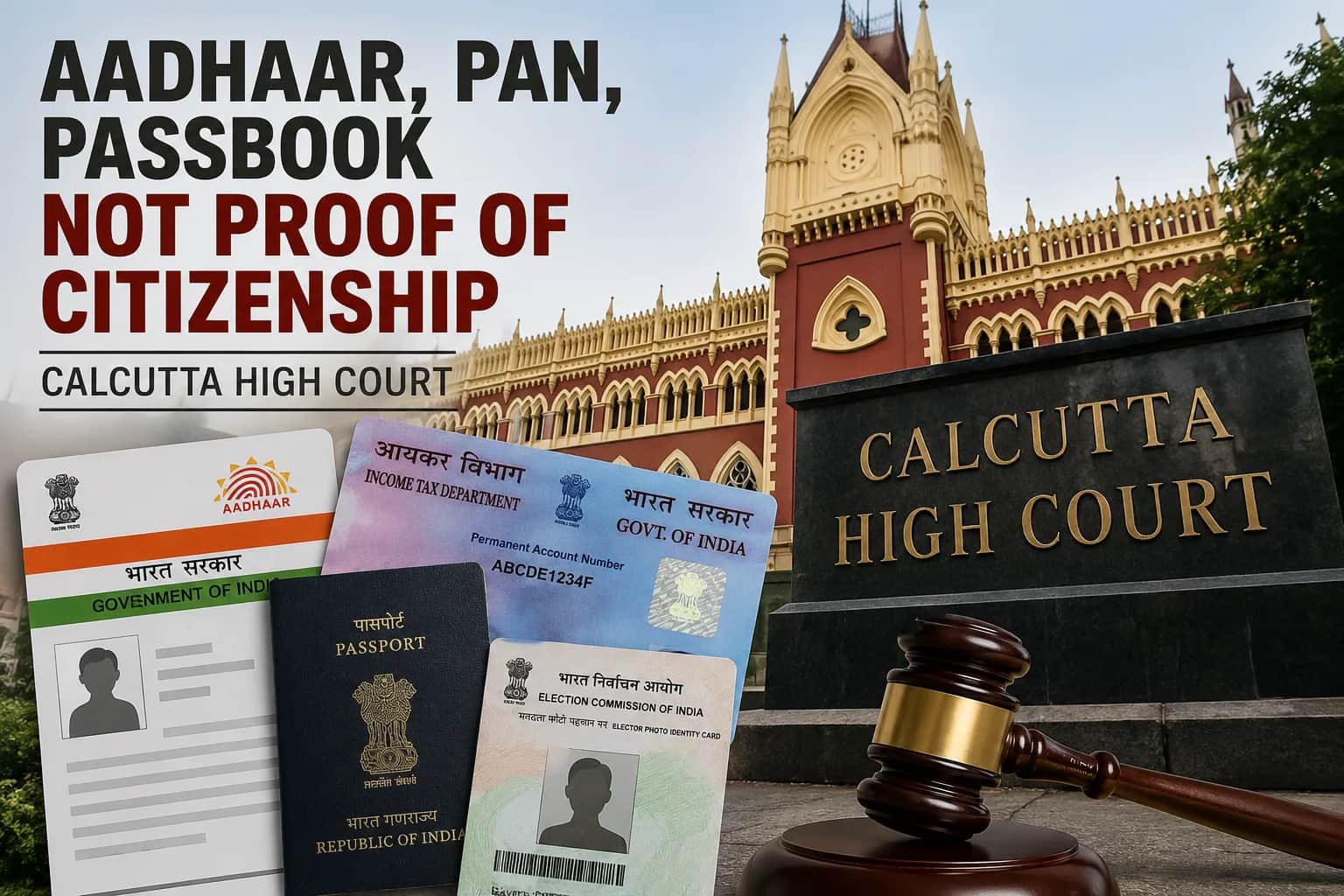
However, the Calcutta High Court has decided that certain documents, including an Aadhaar card, PAN card, voter ID, bank passbook, and land records, cannot be taken as conclusive proof of Indian citizenship. It has been made while deciding on a petition filed by a person staying in the state's Murshidabad district and detained at a detention center as he was suspected of being a Bangladeshi national.
According to a Division Bench of Justice Debangsu Basak and Justice Md. Shabbar Rashidi, they did not wish to intervene in the matter as various issues regarding inconsistencies in certain documents needed to be sorted out first. It has been made clear that citizenship will have to be proved according to the provisions of the Citizenship Act and not through common usage documents or financial documents.
Moreover, it has also been stated that documents such as land records or bank documents can help prove ownership, residency, or any financial identity but not Indian citizenship. It has been observed that foreigners can also be property owners in India or may possess certain documents as well.
The decision conforms to already established laws. Section 9 of the Aadhaar Act clearly states that the Aadhaar is not an evidence of citizenship or residence. The Indian courts have consistently made a distinction between identity documents and evidence of Indian nationality, stating that Indian citizenship shall be adjudged under the Citizenship Act, 1955.
This ruling has rekindled the discussion regarding what constitutes the valid evidence of Indian citizenship in the wake of ongoing debates on citizenship determination and identity documents. Legal experts believe that this ruling makes it clear that a claim to Indian citizenship should be judged based on the statutory requirements and supporting evidence and not just on one ID document.
"However, the Calcutta High Court has decided that certain documents, including an Aadhaar card, PAN card, voter ID, bank passbook, and land …"